Jacobus Kapteyn Telescope
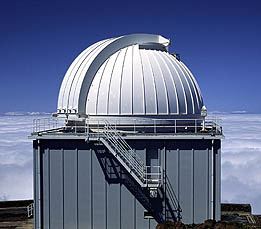 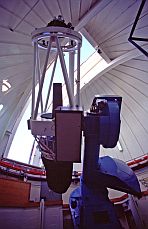
This is the old JKT home page, retained for historical interest.
The JKT was in use by the ING observing community from 1984 until
July 2003. Over the next decade, it remained part of ING,
and was in occasional use for various projects (e.g. SCIDAR
characterisation of atmospheric turbulence above the observatory).
As of 15 Jan 2014 the JKT is owned by the Instituto de Astrofísica de Canarias (IAC),
and is operated by the
Southeastern Association for Research in Astronomy (SARA)
under agreement with IAC. The JKT resumed operations as a robotic telescope in October 2015.
More information can be found in an IAC press release and this paper.
Introduction
The Jacobus Kapteyn Telescope (JKT) has a parabolic primary mirror
of diameter 1.0 m, and two interchangeable secondary mirrors.
The telescope is usually fitted with the
hyperboloid secondary mirror, which gives a conventional f/15 Cassegrain focus.
The alternative f/8.06 Harmer-Wynne system uses a spherical secondary and a
doublet corrector to give a field of 90 arcmin diameter for
photographic astrometry over a wide field.
The JKT is equatorially mounted, on a cross-axis mount, which allows operation east or west of the pier. Normally it is east of the pier.
The observing limits are currently:
-
Zenith distance < 84 deg
-
-6 h < hour angle < +18 h (telescope East of pier)
-
-18 h < hour angle < +6 h (telescope West of pier)
There are no explicit declination
limits. The fully-lowered windshield which sits on the dome lintel sets a further limit. Because of the asymmetry of the telescope, the limits are different east and west of the pier.
A more detailed description of the optics and the mounting of the JKT is
available in the Observers' Guide.
For more information about the Telescope Control System please see the JKT TCS manual. For other
documents see the manuals for JKT instruments.
For more information about the JKT, see the
public information web pages.
Instruments
The JKT was offered to visiting astronomers
with the 2k × 2k SITe2 CCD camera and the JAG autoguiding box.
The
camera provides an unvignetted field of view of 10 × 10 arcmin, with a
pixel sampling of 0.33 arcsec.
Observing
Most of the information required for operating the telescope can be found in the
Observing
Guide
and in the
Observers'
Guide to JKT JAG-CCD imaging.
An ALPHA station lpas1 runs the
telescope control system.
Computer lpss10 hosts the observing system, i.e.
data acqusition (UltraDAS), instrument control (ICS) and data inspection
(IRAF).
NB at ZD >~ 45 degrees in the west, the tracking is poor.
Jumps in tracking typically manifest themselves as
double images on the CCD.
Observers should therefore plan their observations to aovoid HA > 3 hours.
Quality Control
Reflectivity/scattering plots for the JKT mirrors:
Coordinates of the JKT
| Coordinates of the JKT |
|---|
| Latitude: | 28° 45' 40.1" N (+28.761°) |
| Longitude: | 17° 52' 41.2" W (-17.878°) |
| Ground floor height: | 2364 m |
|