|
The limiting magnitude of an IR instrument depends on the required signal to noise ratio, the exposure time, the sky background brightness and, for point sources, on the seeing. Using an equation of McLean (1997),
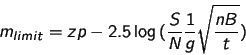
where
|
zp |
instrumental zeropoint in ADU/s (a source with this magnitude creates 1 count/sec) |
|
S/N |
required signal to noise ratio |
|
g |
instrumental gain factor (approximately 5 e-/ADU) |
|
n |
number of pixels covered by a point source (n = 50 * seeing2) (50 = π / pixscale2) |
|
B |
number of electrons created by the sky background per second and pixel |
|
t |
total integration time on target |
The following table lists characteristics measures for LIRIS as determined during the first commissioning in February 2003. Note that B can vary by a factor of 2.5 and more, depending on the season and the solar cycle. In J and H, B is dominated by airglow, whereas in Ks the temperature of the atmosphere determines B. Typically, the infrared sky brightness is smaller in winter and during periods of small solar activity.
The limiting magnitudes given are calculated for a one hour on-source integration in 0.7" seeing.
|
|
J |
H |
Ks |
|
|
|
zp |
24.83 |
25.17 |
24.55 |
|
Total throughput |
0.34 |
0.53 |
0.52 |
|
B (mag/arcsec2) |
15.4 |
14.2 |
13.0 |
|
B (e-/s/pixel) |
365±180 |
1500±800 |
2600±300 |
|
mag lim (3 σ) |
23.4 |
22.4 |
21.8 |
IAC will provide a stand-alone exposure time calculator for LIRIS.
For the time being you can also use SIGNAL. Therein, select the INGRID detector since LIRIS is not yet included. INGRID has very similar properties to LIRIS and thus SIGNAL will provide you with a reasonable estimate for your exposure time.
|