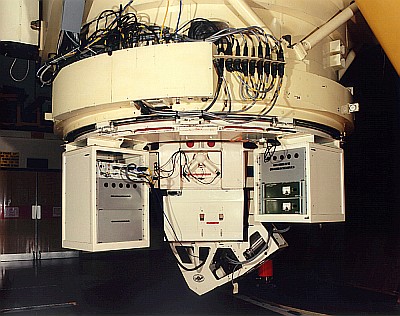
The Intermediate Dispersion Spectrograph (IDS) is a long-slit spectrograph
which sits at the Cassegrain Focal station of the
2.5m Isaac Newton Telescope and is
equipped with a 235-mm focal length camera.
IDS is offered with two 4096×2048 pixels CCD detectors: RED+2 (default detector) a red-sensitive, low-fringing array and EEV10 a blue-sensitive array.
IDS has a set of 16 gratings available. Possible grating and CCD combinations
allow dispersions between 0.24 and 4 Å per pixel. The spatial
scale is 0.4 and 0.44 arcsec per pixel for EEV10 and RED+2 detector, respectively. The full unvignetted slit length is 3.3 arcmin.
The SIGNAL program
(S/N calculator) contains reliable updated measurements of the IDS throuhgput
with the two cameras, with an accuracy of some 20%. You can then safely use
it to estimate your exposure times.
In case of long runs covered by several observers, please let us
know well in advance so that, if necessary, an INT Support Astronomer is scheduled to support the new observer on the first night.
IMPORTANT! Please read carefully the information about filling the IDS cryostat. For any question contact you INT SA.