The AUXCAM engineering page provides information
about the CCD bias level, read noise, gain, readout time and
quantum efficiency.
For convenience, a summary table of properties from that page
(as of July 2018) is reproduced here:

but refer to the engineering page for the latest information.
AUXCAM is a low-fringing, deep-depletion 2k * 4k EEV CCD (15-micron pixels)
similar to RED+ on ISIS.
The QE outside the wavelength range plotted on the above-linked page can be
found on
EEV's pages, e.g. in the red the QE drops smoothly to
zero at ~ 1.05 micron.
A history of the bias level, readout noise etc. can be found on the
CCD quality-control pages.
Useful area
The CCD is typically windowed to [1:2148,800:3300].
This includes the whole area illuminated during either imaging
(0.25 arcsec/pixel) or spectroscopic observations.
Binning
The CCD can be binned at least x2, x3 and x4 without problems.
Binning up by more than this may yield unpredictable results e.g.:
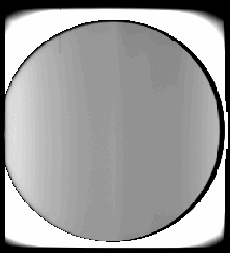
looks like a focal-plane filter mount illuminated by light from within
ACAM,
but is actually a 10x10 binned image of a heavily saturated flat-field.
Bias, overscan region
As is the case for most ING CCDs, the bias can be characterised as
B(x,y,t) = f(x,y) + g(t), where f(x,y) is a fairly stable pattern of
pixel-to-pixel variation, and g(t) represents the variation with time
(typically a few to 10s of counts on a timescale of hours to nights).
f(x,y) can be measured by taking a median of daytime bias frames.
g(t) is usually measured from the overscan region of each science observation.
The region 10 < x < 50 can be used to estimate g(t).
Columns 1 < x < 6 (just visible below)
have lower counts and should not be used when measuring g(t).

A nominal mean bias level is set in the CCD readout code,
but the actual bias level depends on which CCD controller is used.
The nominal value is therefore set high enough to ensure that there
is no risk of the actual bias going below zero.
ACAM bias frames should not be obtained simultaneously with biases on ISIS
- this results in horizontal features (at a level of a few counts)
on both sets of biases. An example ACAM bias affected in this way
is shown below
(click on image for an enlargement):

Flat-field
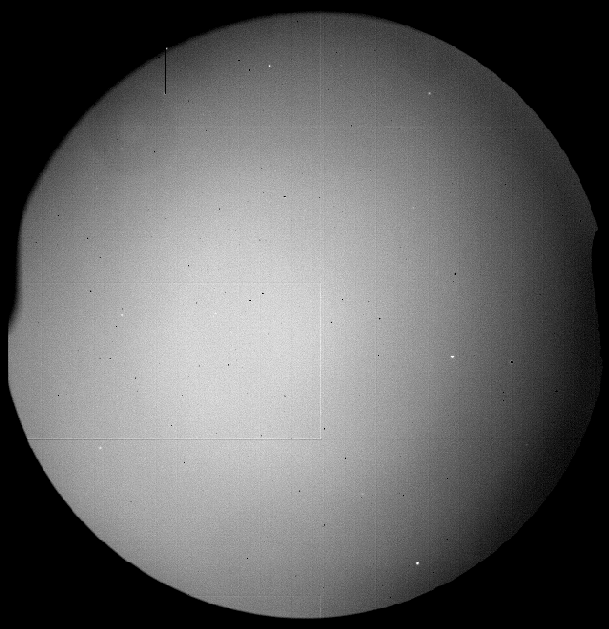
Sky flats (example below left) trace pixel-to-pixel variations
in sensitivity across the CCD, rms ~ 1%.
A few rows and columns
show few-% reduced or enhanced sensitivity, in particular a row and column
meeting
near (default-windowed) x,y = 1074, 741 (area shown magnified at right).
The affected rows and columns are probably 'stitch boundaries' arising
in manufacturing.
At the top left of the field of view (click on the image below
for an enlargement) is a single column with only ~ 10% sensitivity,
running upwards from (default-windowed) x,y = 566, 1875.


The ~ 100 - 200 black dots visible in the flat-field image
are groups of typically 2 - 3 pixels whose sensitivity is low by a few 10s %,
as a result of manufacturing flaws (a few of the dark spots might also
be due to contamination by
small dust particles).
All of the above-mentioned features should flat-field out, but
observers
may want to avoid placing critical targets near (default-windowed)
x,y = 1074, 741.
The white spots in the above late-twilight image are stars.
Cosmic rays
The cosmic-ray rate is ~ 130 per Mpixel per hour. Cosmic-rays
typically leave tracks 2 pixels wide, and deposit ~ 1000 counts
per pixel. Most tracks are 2 - 10 pixels long.
In a typical half-hour dark exposure, the largest events
will leave tracks ~ 100 pixels long (~ 100k counts).
Cosmic rays can also appear in bias frames e.g.:

Dark current
The dark current is usually a few counts/pixel/hour, unless the CCD warms,
in which case an ACAM bias frame may look like this:

with a characteristic gradient in the y direction:

Cryostat
AUXCAM is housed in a cryostat with an
optically-active window, i.e. the window is
part of the ACAM optical train (which greatly simplified
the design of the instrument).
For this reason, the cryostat cannot be moved, e.g. for focusing.
Any focusing required is achieved by moving the WHT's
secondary mirror.
The cryostat window is 5 mm thick. The distance between the back of the window
and the front of the CCD is 5.9 mm.
Shutter
The (Prontor) leaf shutter lies in the light path just after the filter wheels,
and just before the main
lens barrel.
It has a clear aperture of 64 mm.
The count levels on a series of exposures with
requested integration times
2, 1, 0.5, 0.25, 0.13, 0.06, and 0.03 sec suggest that
the overhead for opening and closing the shutter is ~ 0.04 sec.
Exposures of 0.02 and 0.01 sec are also possible, and yield
fewer counts, but it's not clear that the shutter is opening fully.
If an exposure time of 0.005 sec is requested, the exposure fails
(to clear the error state, repeat with a longer exposure time).
We recommend a minimum exposure of 2 sec for observations
of photometric standards.
*** During 2019, the ACAM shutter has been showing signs of wear, and on
a few occasions it has not fully opened.
The current plan is to service the
mechanism in late 2019. In the meantime, keep an eye on the photon counts
from objects of known apparent magnitude.
If the counts appear lower than expected,
the telescope operator can check from engineering control the true status of the
shutter.