Shell galaxies
With a wide-FOV integral-field spectrograph we can look for and study kinematic and stellar-population signatures in shell galaxies.
To that end, I have obtained WEAVE/LIFU data for a number of prototype shell galaxies. Questions being addressed are:
- Do the velocities, velocity dispersions and Gauss-Hermite high-order terms show differences at the shells.
- Are there stellar population differences between shell and inter-shell lines of sight.
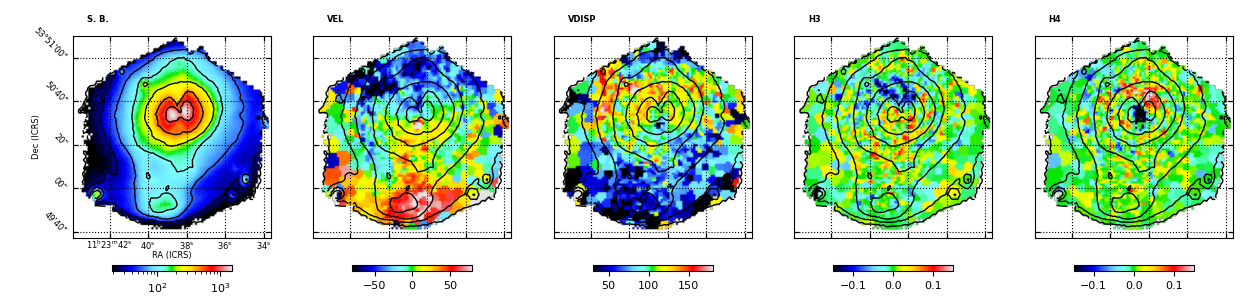
The figure below shows stellar kinematic maps of the peculiar elliptical NGC 3656, from WEAVE/LIFU low-resolution observations. Left to right, the plots show: surface brightness; line-of-sight velocity; line-of-sight velocity dispersion, and high-order Gauss-Hermite terms H3 and H4. Kinematics were computed with PPXF running under the WEAVE Advanced Processing System PyAPS. The data show that the bright shell to the south has 60-80 km/s higher velocity than the main body. The velocity dispersion map shows a pronounced north-south asymmetry; and H3 is not antisymmetric with the velocities, a possible sign that the central dusty structure is a bar, not a disk.
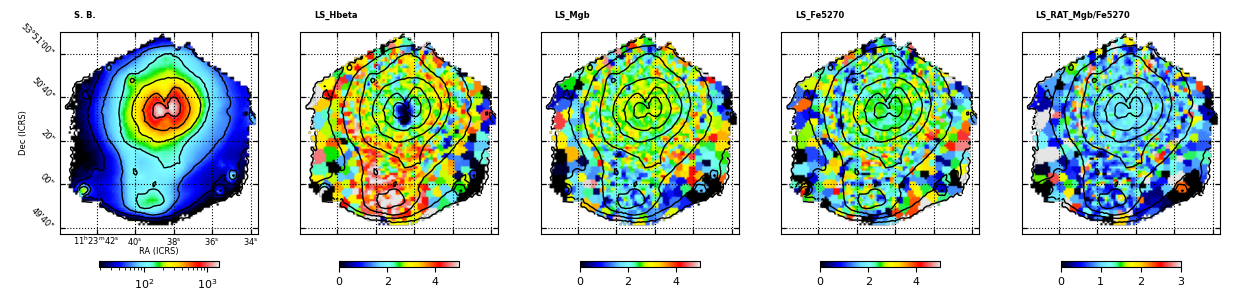
Beyond kinematics, chemical composition information contained in the spectra of shell galaxies adds clues on the merger processes that led to formation of shells. The image below shows line-strength maps of Hbeta, magnesium, iron, and the Mg/Fe ratio. Line strengths can be measured from 3800 A to about 9300 A. From these maps one immediately infers that the stars in the accreted galaxy that is creating a shell at the south of NGC 3656 are younger than in the main body, because their Hbeta is higher. And those stars have lower metal content, because both Mg and Fe are lower.