Planetary Nebulae
Planetary nebulae are shells of gas thrown out by some stars near the end of
their lives. Our Sun will probably produce a planetary nebula in about 5
thousand million years. They have nothing at all to do with planets; the terminology
was invented because they often look a little like planets in small
telescopes. Planetary nebulae are formed in the process of mass loss during
which red giant stars ultimately become white dwarfs.
1 2
2
Description:
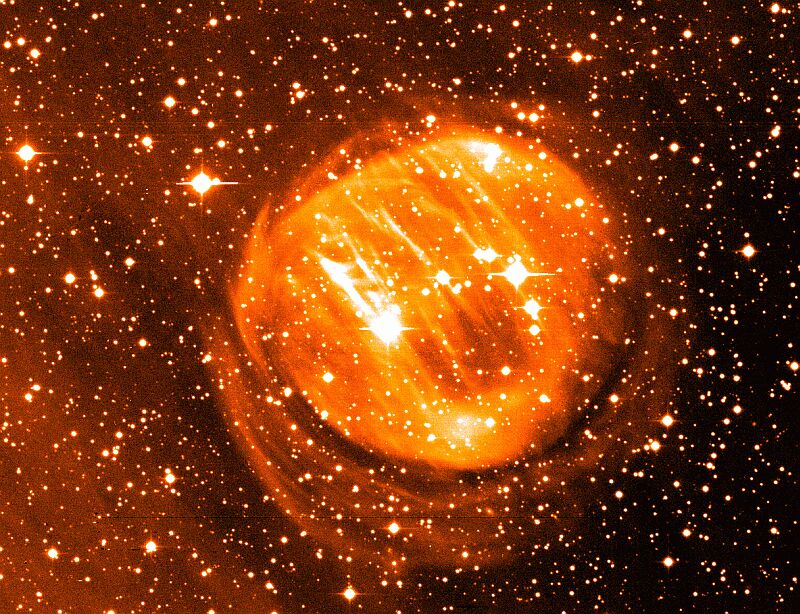
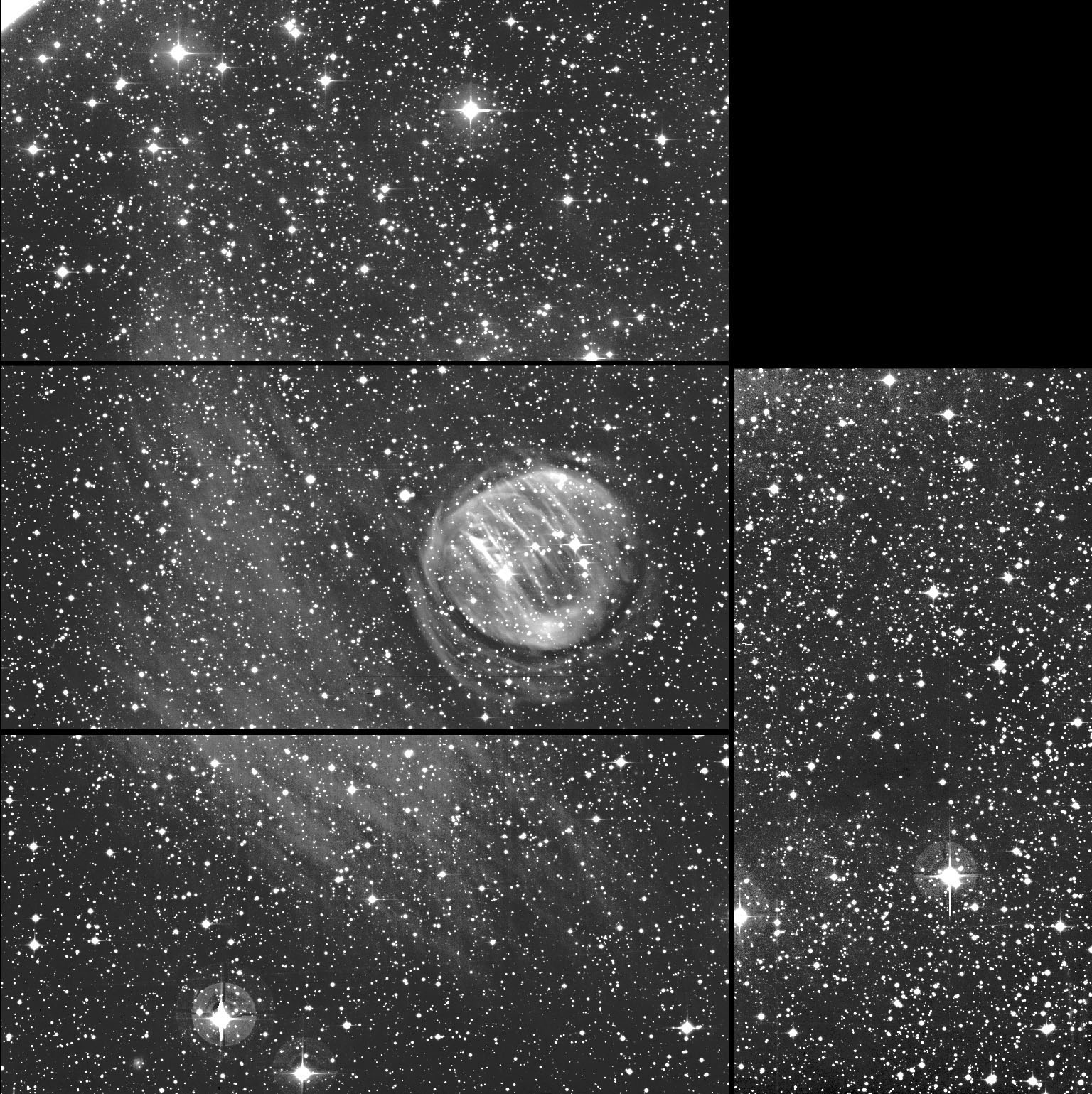
Image of the planetary nebula Sharpless 2-200. This is a very evolved
planetary nebula, whose central star has already
faded to a low luminosity after exhausting all circumnuclear fuel. Around
the filamentary inner nebula, a large faint halo is observed. This halo
might be interstellar gas ionized by the central star of the planetary
nebula, or alternatively ancient material
ejected by the star itself when it was a red giant some 50 to 100 thousand
years ago. These haloes provide very precious information about the
various events of strong mass loss at the end of life of solar type stars.
These mass loss events are the ultimate cause leading to the death of
these stars.
Date: Image 1: 2001. Image 2: 2001.
Credit: Image 1: Romano Corradi (ING) and Nik Szymanek. Image 2:
Romano Corradi (ING).
Technical information: Image 1 and 2 were obtained with the
Wide Field Camera at the 2.5m INT telescope. A narrow filter
has been used to isolate the emission from the nebular gas in the hydrogen
Halpha line (at wavelength 656 nm) and in the nitrogen doublet [NII] at
lambda 655 and 658 nm.
Available formats: JPEG (593 K) | TIFF (3,038 K) | JPEG (158
K) | TIFF (362 K)

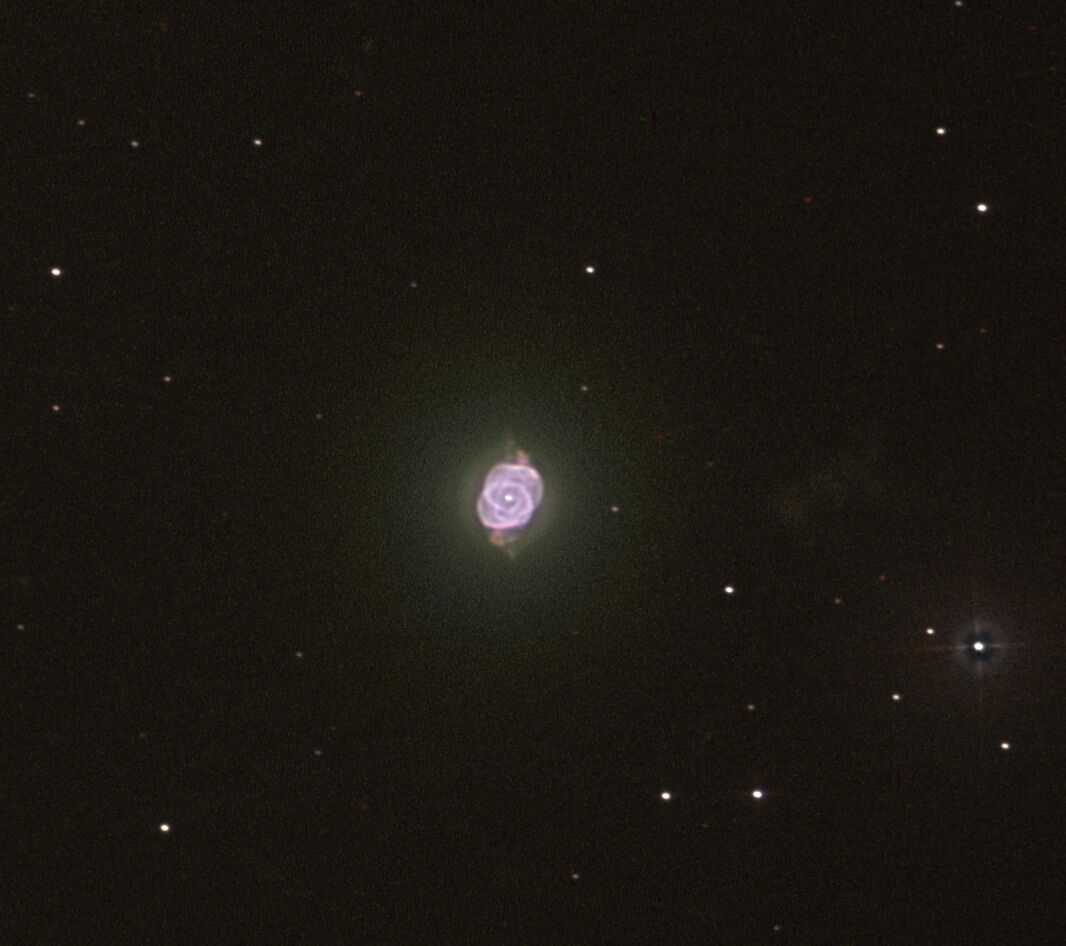
Description:
NGC 6543, nicknamed the the Cat's Eye Nebula, is one of the most complex of
the planetary class nebula, stars that throw of spheres of gas at the end of
their lives. It is located in the constellation Draco and is thought to have
been created 1,000 years ago by two stars orbiting each other.
Date: August 2001.
Credit: Cornwall Astronomy School Project.
Technical information: This B, V, R image was taken using the Jacobus Kapteyn telescope and the SITe2
detector.
Available formats: JPEG (93 K) | TIFF (1,973 K)
1 2
2
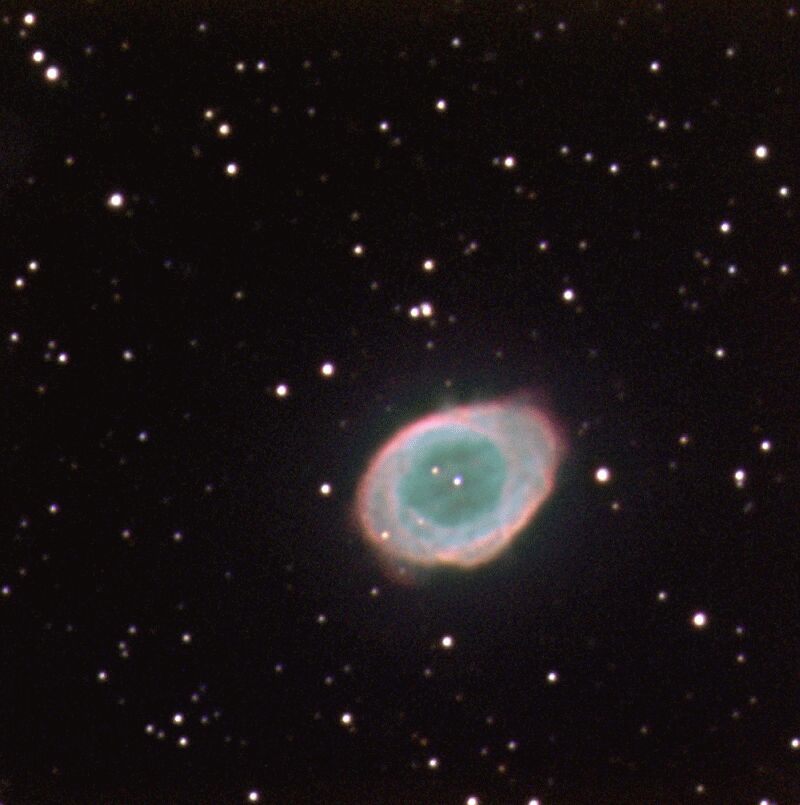
Description:
M57 planetary nebula, also known as the "Ring Nebula". The famous ring
nebula M57 is often regarded as the prototype of a planetary nebula,
and a showpiece in the northern hemisphere summer sky. Recent research has
confirmed that it is, most probably, actually a ring (torus) of bright
light-emitting
material surrounding its central star, and not a spherical (or ellipsoidal)
shell.
Date: Image 1: 1999. Image 2: 1995.
Credit: Image 1: Daniel Folha and Simon Tulloch (ING). Image 2: ING
Archive and Nik Szymanek.
Technical information: Image 1: This true-colour
image was taken using the Jacobus Kapteyn telescope and the SITe2
detector. Image 2: Jacobus Kapteyn Telescope, Tek CCD, B, V and R filters.
Available formats: Image 1 JPEG (49 K) | Image 2 JPEG (59 K) | Image 2 TIFF
(11,746 K)

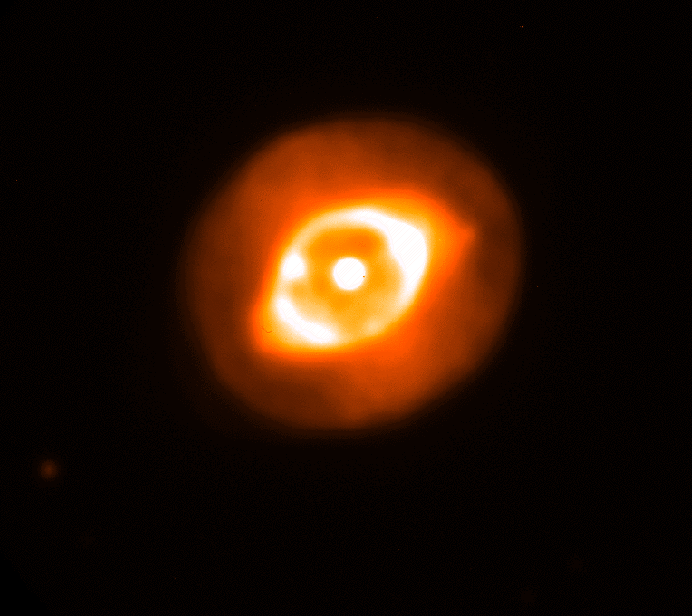
Description: NGC 3242 planetary nebula. The "Ghost of Jupiter" is a
planetary nebula which has a nearly spherical outer shell with an elliptical
inner ring that gives it the
appearance of an "eye". In this image it's also possible to see the
central illuminating star.
Date: 2000.
Credit: Javier Méndez (ING).
Technical information: Image acquired with the Auxiliary Port Camera
on the WHT, through filter R. Exposure time was 100 seconds.
Available formats: GIF (92 K)

Decription: M2-9 planetary nebula. M2-9, a butterfly planetary
nebula 2100 light-years away, has wings that tell a strange but incomplete tale. In
the center, two stars orbit inside a gaseous disk 10 times
the orbit of Pluto. The expelled envelope of the dying star breaks out from
the disk creating the bipolar appearance.
Date: 2000.
Credit: Javier Méndez (ING).
Technical information: Image acquired with the Auxiliary Port Camera
on the WHT, through filter R. Exposure time was 100 seconds.
Available formats: GIF (94 K)
1 2
2 3
3
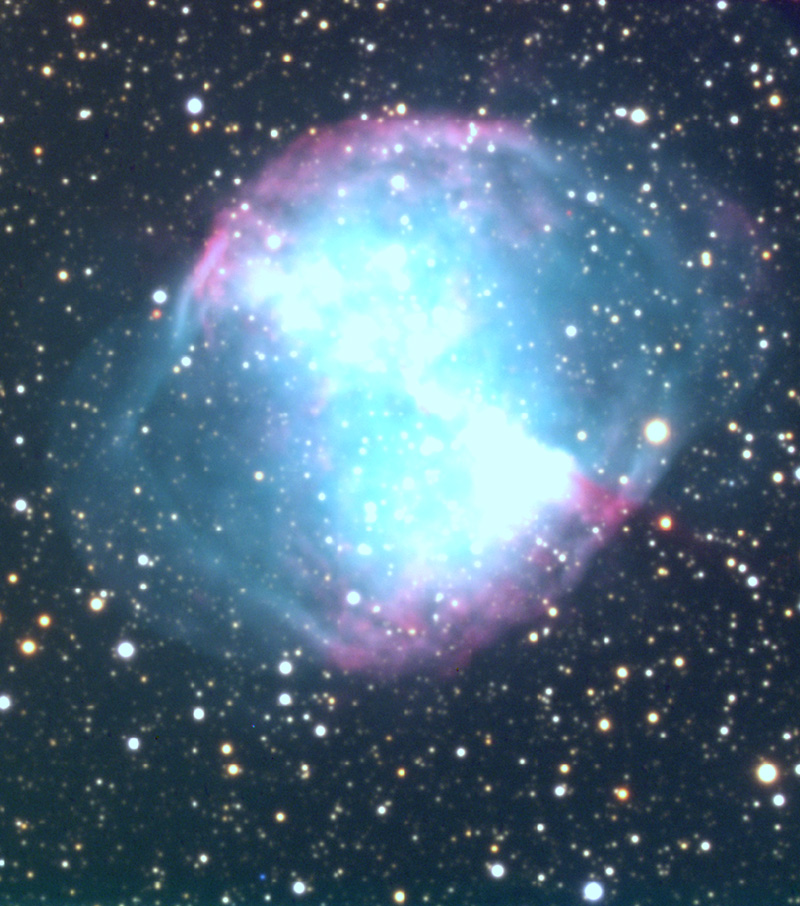
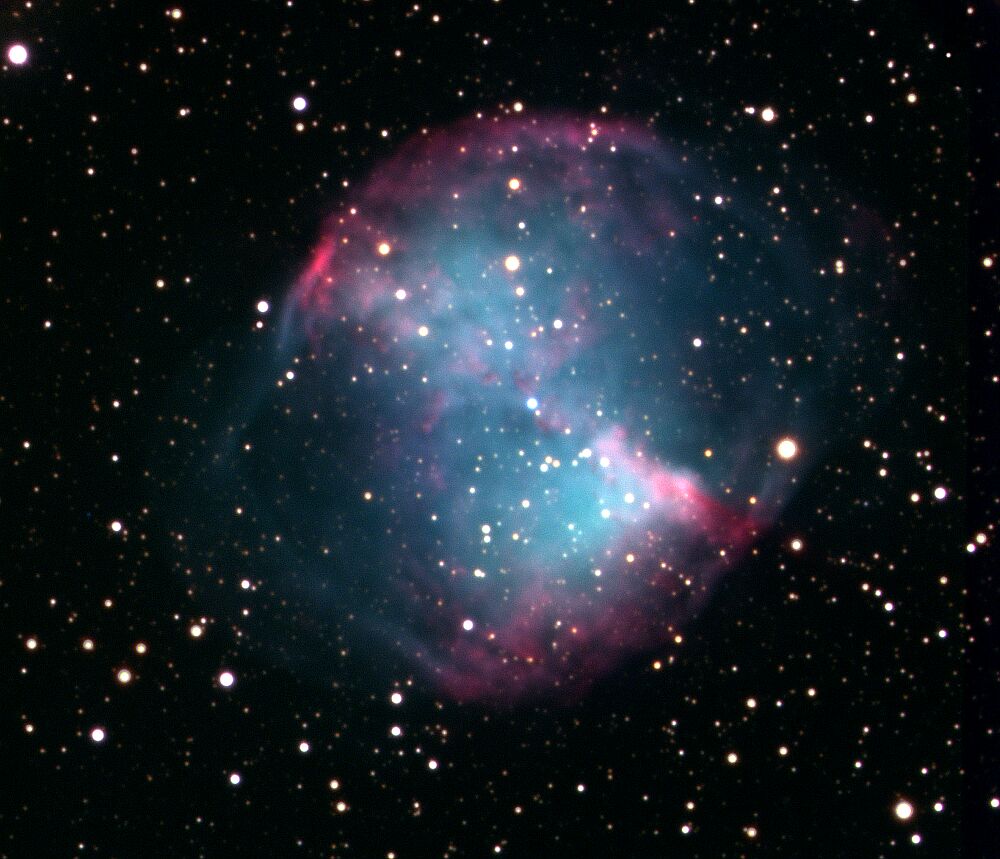
Title: M27, NGC 6853, the Dumbell nebula.
Description: The Dumbell nebula
was the first planetary nebula ever discovered. We happen to see this one
approximately from its equatorial plane; from near one pole, it would
probably have the shape of a ring, and perhaps look like we view the Ring
Nebula M57.
Credit: Image 1: Copyright Malin-IAC-RGO. Image 2: Amanda Willmott,
Aaron Shrimpton and Javier Méndez. Image 3: Amanda Willmott, Aaron
Shrimpton, Javier Méndez and Nik Szymanek.
Date: Image 1: 1992. Image 2: 2000. Image 3: 2000.
Technical information:
Image 1 1: Photographic 3-colour composition from the
Isaac Newton Telescope. Image 2: True-colour composition from B, V, and R imaging using a CCD
camera on the JKT. Image 3: Same as before but colour-processed by Nik Szymanek.
Available formats: Image 2: JPEG (248 K) | Compressed TIFF (9,177 K). Image 3: JPEG
(109 K) | TIFF (14,392 K)

 2
2 3
3