GMOS /
bHROS fibre connection
M.F. Blanken (ING), R.G. Talbot (ING), M. Aderin (UCL).
Over the last year (2002-2003) ING was subcontracted by University College London (UCL) to produce a module of 18 science fibres for the GMOS / bHROS project on the Gemini South telescope conducted by.
bHROS is a high-resolution (R=150,000) echelle spectrograph, mounted in the pier of Gemini-South. It is fed by optical fibres mounted on the GMOS instrument located at the Cassegrain focus of the telescope. bHROS will have the highest spectral resolution among the optical spectrographs currently being designed and built for 8-10m class telescopes.
The optical fibre connection between GMOS and bHROS consists of 18 fibres; 9 fibres with a 120µm core diameter and 9 fibres with a 160µm core diameter. Both types of fibres had to be ground and polished at both ends. The GMOS end had to be mounted and aligned in an optical assembly (a body plate). The 10 fibres of 160µm and the 10 fibres of 120µm were sent to the ING of which 9 of both types had to be used for science, 1 fibre of both types were in case of any breakage. The first stage after receiving the fibres was cutting them on the desired length. After this metal tubes were glued over the fibre ends to make the grounding, polishing and handling easier. The metal tubes were also connected to the outer PTFE sleeve of the fibre, using heat shrinks, to give extra strength and reduce the risk of breaking. Both ends of the fibres were ground and polished to a flatness of <¼ of a wavelength (632nm).
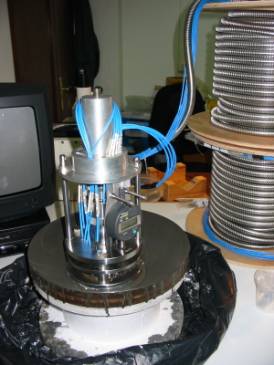
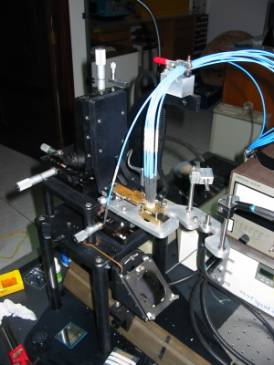
The body plate for the GMOS end consists of 18 sapphire ball lenses (3-4mm diameter) and 18 silica optical windows (3-4mm diameter and 300-400µm thick). The balls and the windows were glued in the body plate using UV-optical curing glue. Before the fibres were aligned in the body plate a throughput test was done to check the relative transmission of the 20 fibres. The best 18 fibres were aligned on top of the silica windows and the sapphire ball lenses in the body plate. The alignment was done to a target that simulates the Gemini telescope pupil (fibre positioning tolerances were 0.02mm). After the alignment the fibres were glued in the body plate by using the UV-optical curing glue and super glue.
After the polishing, aligning and gluing the fibres were sent to the UK for further production on the bHROS end. The fibres are now installed between GMOS and the bHROS instruments in Chile. First science with the instrument is expected in August 2003.
ING is specialised in fibre work after making several successful fibre projects. One project in particular, “Small fibres” consisted out of 160 fibres with a core diameter of 90µm. The procedures and experience of the “Small fibres” project were used in the GMOS / bHROS project. ING is looking forward to more fibre work in the future.
For more information on the GMOS / bHROS project please visit the following sites:
· Gemini South telescope: www.gemini.edu
· HROS project page: www.osl.ucl.ac.uk/hros/new/fm-index.html
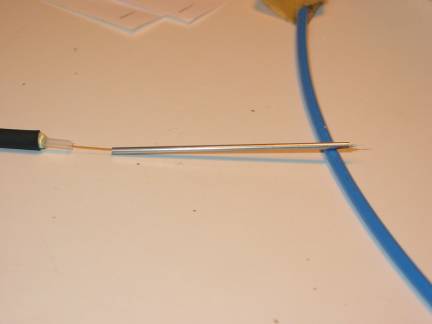
Picture 1: Metal tube gluing