Do it dry… INT primary “vapour cleaning”
M.F. Blanken, A.K. Chopping, K.M. Dee (ING)
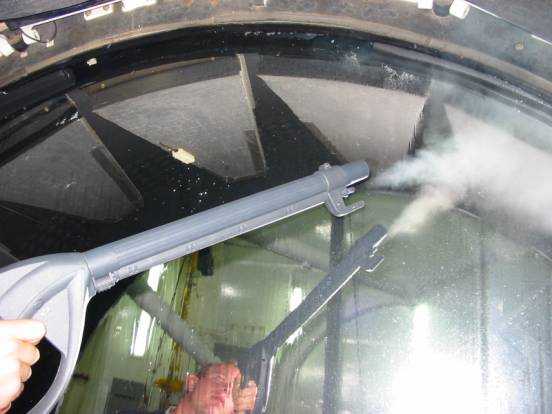
Last month for the first time in the long history of the Isaac Newton Telescope, the primary mirror (2.5m) was cleaned using a “vapour cleaning” procedure.
The primary mirrors of the telescopes at the Isaac Newton Group are regularly cleaned. This is done by a method called “snow cleaning” or “CO2 cleaning”. This cleaning method uses liquid CO2 that forms snowflakes once it is in the open air. These snowflakes hit the mirror surface and capture dust particles. The temperature shock between the cold snowflake and the “warm” mirror will easily break the bond between the dust particles and the mirror. The particles together with the snowflakes fall down onto the telescope structure. This way of cleaning the mirrors is quick and easy restoring the reflectivity by about 1-2% and decreasing the scattering.
Unfortunately stains like water and oil cannot be removed using this method. A better way of cleaning the mirror is to use water, soap and natural sponges. First we wet the mirror surface with water to flush away all the big dust particles. By applying pressure and with the use of soap on the sponges the water and oil stains can be removed. After this the rest of the soap has to be washed away by water before drying. The best way of drying is to keep the surface wet until the very last moment when the water is blown away with pressured air.
All the dust and most of the heavy stains can be removed using this method. The reflectivity and scattering can be recovered to values close to those retained after aluminising. Therefore this method is much better than the “CO2 cleaning” method.
The disadvantage of the “washing” method is that it uses roughly 5-10 litres of water per square meter. Handling this quantity of water before and after the washing can lead to a problem because most “old “ telescopes are not designed for water washing. The water can move to electrical or other optical parts leaving all kinds of water damage.
By using water vapour only 1-2 litres of water is used per square meter. Sponges or towels can easily catch this amount of water on the bottom of the telescope structure.
The ING invested in 3 industrial vapour cleaners to be used for the “vapour cleaning” process. Before the machines were used on a telescope mirror, extensive tests were done on similar coated mirrors. It was found that the vapour temperature does not damage the aluminised surface. Only if the vapour gun is pointed for 20 minutes on the same spot can degradation in the mirror coating be seen.
The first advantage of the vapour cleaning starts with wetting the mirror. For this part of the procedure a soapy vapour can be used by pre-mixing water with soap. By wetting the mirror this way, the soapy vapour will start cleaning whilst removing the large dust particles. The pressure of the vapour leaving the vapour gun will blow away the large dust particles instead of flushing them away and leaving marks on the mirror surface. The vapour is heated to a temperature of about 35ºC. Therefore the temperature shock between the warm vapour and this time the “cold” mirror helps to release the particles from the mirror (reverse of the “CO2 cleaning” method). Before drying the mirror surface the soap can be cleaned and the mirror surface can be kept wet with the vapour. Even without touching the mirror surface the “vapour cleaning” will give a better result than the “CO2 cleaning”. Unfortunately to achieve the same results as the “washing” method, sponges and pressure still need to be applied to the mirror surface.
The result of the washing of the INT 2.5m primary was so successful that plans are made to repeat this procedure on the William Herschel Telescope primary (4.2m).
Maarten Blanken
23/07/2003
Picture 1: Vapour cleaning INT primary
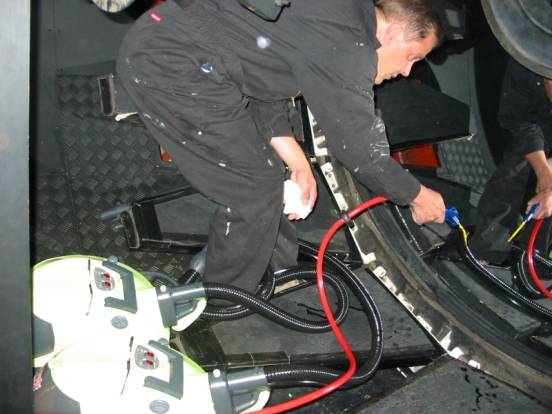
Picture 2: Drying INT primary