|
Telephone:
+34 922 425400
Fax: +34 922 425401 Web: http://www.ing.iac.es/ |
 |
Apartado de Correos, 321
38700 Santa Cruz de La Palma Canary Islands; SPAIN |
|
Telephone:
+34 922 425400
Fax: +34 922 425401 Web: http://www.ing.iac.es/ |
|
Apartado de Correos, 321
38700 Santa Cruz de La Palma Canary Islands; SPAIN |
|
The Isaac Newton Group of Telescopes is an establishment of the Particle Physics and Astronomy Research Council of the United Kingdom and the Nederlandse Organisatie voor Wetenschappelijk Onderzoek of the Netherlands. |
|
|
| Press Release ING 4/2000
Date: Embargo: For immediate release FIRST SCIENTIFIC RESULTS FROM THE WORLD'S MOST ADVANCED OPTICAL CAMERA
A totally new type of optical detector has been used on the William Herschel
Telescope to directly measure
intensity and colour changes in a faint, rapidly variable binary star
system, UZ Fornacis, for the first time. A team from the Space Science Department of the
European Space Agency's Research and Technology Centre in the Netherlands
(ESTEC), who have developed the superconducting detector, were joined by
astronomers from Mullard Space Science Laboratory (MSSL), to exploit
this novel technology.
With conventional optical CCD detectors, very rapid changes in light
intensity cannot be measured. Furthermore, the energy or wavelength
of the arriving photons can only be measured by introducing a filter or
spectrograph into the optical light path, degrading efficiency. With
the new instrument, the so-called S-Cam camera, advanced detector elements based on
superconducting technology register the arrival of each photon
individually, and measure its energy directly.
"This cryogenic
detector is very efficient, very sensitive, and very fast; and there
is no dark current or readout noise" explains Tone Peacock, who has
led the development of the instrument from ESA's Astrophysics
Division. The instrument is cooled to below 1K to minimise all
possible noise, resulting in an almost perfect detector.
Larger and larger telescopes are being built on ground and in space to
study fainter and more distant objects, and more efficient detectors
can contribute enormously to astronomers' progress in understanding.
"We have a very powerful instrument for looking at faint astronomical
sources which vary rapidly, for example pulsars or binary star systems. It
is of particular interest when the light changes its energy
distribution at the same time", said Michael Perryman, who has led
this astronomical investigation.
In the particular binary star system studied, one of the two stars is a
so-called white dwarf, a star in an advanced state of stellar evolution that
collapses slowly under its own gravity. This white dwarf tears
gas from the surface of its nearby companion, which is then engulfed
by the white dwarf's powerful gravitational field. The material is
channelled down highly intense magnetic field lines onto the surface
of the white dwarf, where it emits prolific amounts of optical, ultraviolet,
and X-ray radiation as it cools.
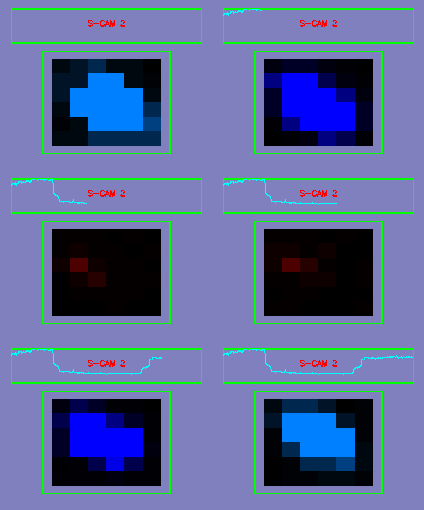
Many clues are contained in the very
short interval of time in which the intense light emitted by the
infalling material is eclipsed by its larger but fainter companion.
The results show that the diameter of the accretion spot, where
material hits the white dwarf surface, is less than about 100 km.
Mark Cropper, from Mullard Space Science Laboratory, has been studying this type of binary system,
known as a magnetic cataclysmic variable, for more than a decade.
"This new detector allows us to look at changes in the light from the
system as it changes over small fractions of a second. And this is the
first time we have been able to study the rapid colour changes which
occur at the same time."
The results of the observations, performed by an ESA technical team
led by Nicola Rando in support of the ESA/MSSL science teams, were made
at the William Herschel Telescope in December 1999, and are reported in the scientific
journal Monthly Notices of the Royal Astronomical Society, October 2000.
ESA scientists Michael Perryman, Clare Foden and Tone Peacock
published the theoretical ideas underlying the new detector in 1993,
the first instrument able to detect the energy of optical photons
directly. Tone Peacock leads the group which reported the first
detection of optical photons using this technique in 1996. The
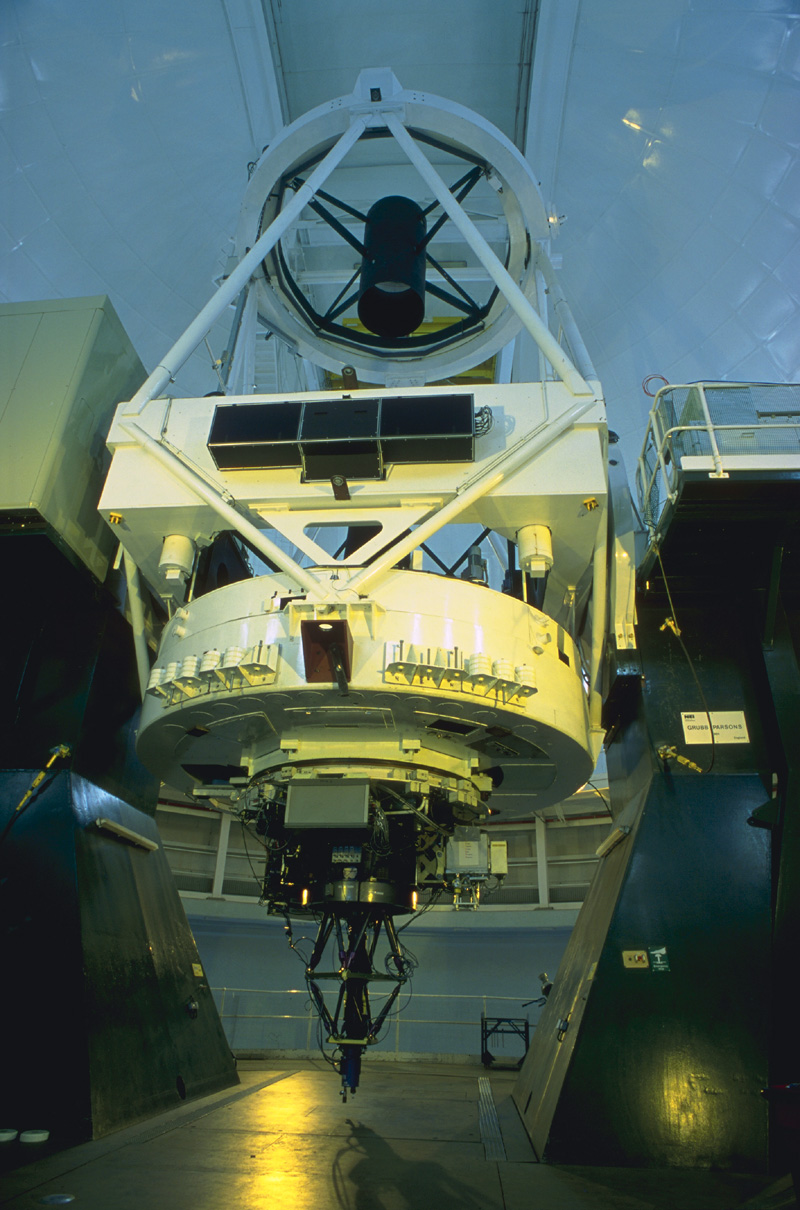
instrument making use of these principles was commissioned at the William
Herschel Telescope
in February 1999 (see ING Press Release
ING 0/99).
The Isaac Newton Group of Telescopes (ING) is an establishment of the
Particle Physics
and Astronomy Research Council (PPARC) of the United Kingdom and
the Nederlandse
Organisatie voor Wetenschappelijk Onderzoek (NWO) of the
Netherlands. The ING
operates the 4.2 metre William Herschel Telescope, the 2.5 metre
Isaac Newton
Telescope, and the 1.0 metre Jacobus Kapteyn Telescope. The
telescopes are located
in the Spanish Observatorio del Roque de Los Muchachos on La Palma
which is
operated by the Instituto de Astrofísica de Canarias (IAC).
PICTURES
FOR FURTHER INFORMATION PLEASE CONTACT:
Dr. Michael Perryman
Dr. Mark Cropper
Mr. Javier Méndez
The
Superconducting Tunnel Junction Page at ESTEC
Astrophysics Division, Space Science Department of ESA,
ESTEC
Mullard Space Science Laboratory
ING Public Information UK mirror
|