|
in 1999* *Astronomical discoveries following from observations carried out with the ING telescopes
[ SOLAR SYSTEM | STARS AND EXTRASOLAR PLANETS | EXTRAGALACTIC | OTHER HIGHLIGHTS ]
THE FAINTEST KUIPER BELT OBJECTS INT+WFC Starting in 1992, astronomers have become aware of a vast population of small bodies orbiting the Sun beyond Neptune. There are at least 70,000 "Trans-Neptunians" with diameters larger than 100 km in the radial zone extending outwards from the orbit of Neptune (at 30 AU) to 50 AU. There may be many more similar bodies beyond 50 AU, but these are presently beyond the limits of detection. This population is generally referred to as the Kuiper Belt. The Kuiper Belt holds significance for the study of the planetary system on at least two levels. First, it is likely that the Kuiper Belt objects are extremely primitive remnants from the early accretion phases of the Solar System. The inner, dense parts of the pre-planetary disk condensed into the major planets, probably within a few millions to tens of millions of years. The outer parts were less dense, and accretion progressed slowly. Evidently, a great many small objects were formed. Second, it is widely believed that the Kuiper Belt is the source of the short-period comets. It acts as a reservoir for these bodies in the same way that the Oort Cloud acts as a reservoir for the long-period comets. Recently, two new Kuiper Belt objects have been discovered, named 1997 UG25 and 1997 UF25, and they are some of the faintest objects ever seen orbiting our Sun. One is estimated to be 150 km across and the other 110 km. Both are about 45 times farther from the Sun than Earth (4,200 million miles or 6,750 million kilometres), and more remote than the planet Pluto. Based on present ideas about how Kuiper Belt objects formed, astronomers expected to be finding these faint objects at even greater distances. Since they did not, those ideas may need to be revised. It may be that the average size of the Kuiper Belt objects is smaller the farther away they are, so the most distant ones were too faint even for this survey. Or it might be that the objects actually discovered mark the outer edge of the Kuiper Belt. The discovery team used the prime focus Wide-Field Camera at the Isaac Newton Telescope to image the sky for 7 nights, searching a total area slightly smaller than that covered by the full Moon. During each night they stared continuously at different patches of sky for up to four hours at a time. In each patch of sky several thousand distant stars and galaxies could be seen. However even these images were not sensitive enough to record the Solar System objects the team were seeking. So they combined the images by computer in a way that eliminated all stars, galaxies and nearby asteroids and revealed only faint solar-system objects at large distances from the Sun. References:
PROBABLE DETECTION OF STARLIGHT REFLECTED FROM THE GIANT PLANET ORBITING TAU BOÖTIS WHT+UES The search of exoplanets (planets orbiting other stars different than our Sun), is one of the major quests in the history of the humanity. During the last decades, this dream turned into reality when Doppler shifts in the spectra of some bright, nearby stars were measured, indicating the presence of massive planets orbiting these stars. This technique, just like most other methods to find planets around stars does, however, not tell us much about their size and composition, as it only measures the influence of the planet on the star. Direct evidence for the detection of light from a planet was only found recently with WHT, although this detection has remained controversial since. A.C.Cameron (St.Andrews) and his group for the first time measured the light from a distant planet around the star Tau-Boo, and were able to determination some of its physical characteristics. They employed the UES high resolution echelle spectrograph on the WHT to take high quality spectra of the star Tau-Boo, which also contained light reflected off the planet. The spectrum of the planet was obtained by subtracting the light of the star. This required extremely careful data reduction techniques to be applied to the data, in order to extract the very faint light signal from the planet. This planetary spectrum (producted by the reflection of the light coming from its parent star) was the first direct detection of an exoplanet. The data allowed a study of its characteristics, such as its size, mass, distance from the star, color, and temperature. The planet was named the Millenium planet, since the discovery was announced just before start of the year 2000. Because the detected signal is very faint the discovery has aroused much discussion and has been controversial. Measurements continue to pin down this finding.
COSMIC FLOW OF GALAXIES ACROSS ONE BILLION LIGHT YEARS OF THE UNIVERSE WHT+ISIS, INT+IDS and JKT+CCD A mass migration of galaxies was
first reported some years ago. This migration seems to be taking place
on a huge scale (hundreds of millions of light-years), but was this migration
real? Different studies presented conflicting conclusions. In order to
test whether mass migration of galaxies is indeed happening a projects
was undertaken to measure the velocity and distance to hundreds of galaxies.
Many telescopes were used in this survey, including the WHT, INT and JKT.
As a result of these measurements it was recently reported that the bulk
flow is confirmed.
GAMMA RAY BURST 990123: NEW LIGHT ON THE UNDERSTANDING OF THESE OBJECTS JKT+CCD Gamma-Ray Bursts (GRB) are believed to be the largest explosions in the universe since the Big Bang. They are thought to arise when an extremely relativistic outflow of particles from a massive explosion interacts with material surrounding the site of the explosion. Multi wavelength observations, following their light-curves, are needed to understand the nature of the explosions. The time scale of the decay since the gamma-ray explosion is detected is about 10 days: the brightness of the optical counterpart can decrease about fifteen magnitudes over this period. Therefore, a quick and accurate determination of the position of the optical counterpart and the follow-up photometry of the source is crucial, which requires a global observing campaign, involving many telescopes. On 23 January 1999 one of the brightest GRBs ever seen was detected by the BATSE satellite. Observations at optical, infrared, sub-millimetre and radio wavelengths were obtained of the object. In this effort JKT was involved, contributing to the photometric light-curve at multiple wavelengths. These observations revealed that the optical and gamma-ray light curves are not the same. This was the first time that the three different regions involved in the emission process were seen: the internal shocks causing the GRB, the reverse shock causing the pronounced optical flash, and the forward shock causing the afterglow. Links between supernovae and gamma ray burst strengthens WHT/PF and INT/PF The discovery of both an X-ray and
optical afterglow to GRB 970228 by the WHT and INT revolutionised the study
of gamma-ray bursters. The mean temporal and spectral properties of this
afterglow appeared to be consistent with the relativistic fireball model.
However, now that more data has been gathered on several gamma-ray bursts,
not all of them appear to fit the fireball model. One of them is GRB 970228.
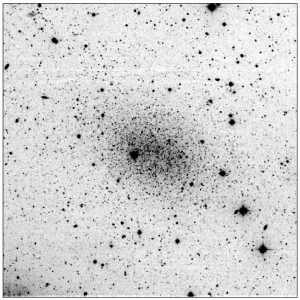
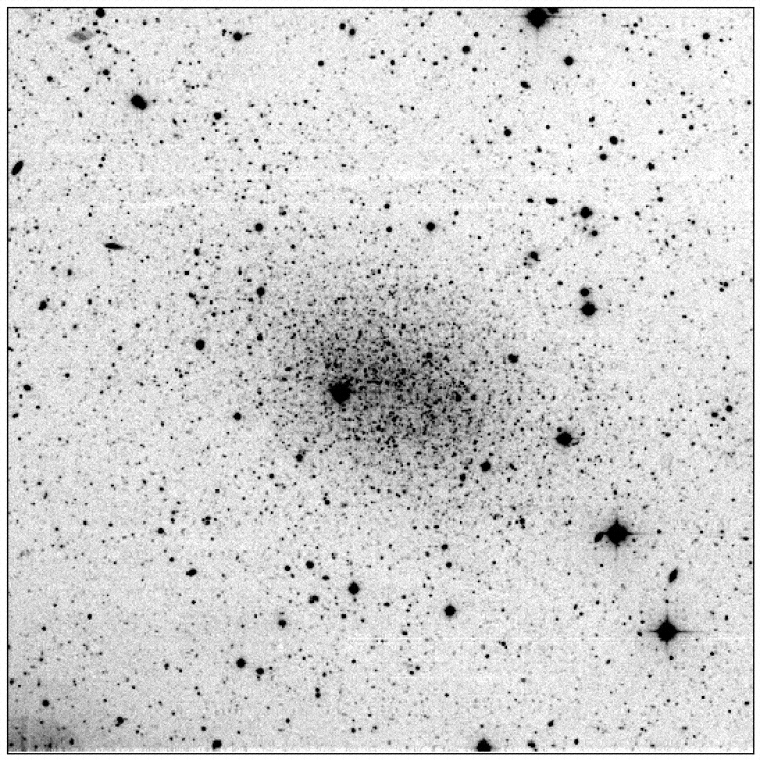
EVIDENCE FOR A MASSIVE BLACK HOLE IN THE SO GALAXY NGC 4342 WHT+ISIS Several lines of evidence suggest that active galactic nuclei (AGNs) are powered by accretion onto super-massive black holes. The much higher volume-number density of AGNs observed at redshift z ~ 2 than at z ~ 0 suggest that many quiescent (or “normal”) galaxies today must have gone through an active phase in the past, and therefore harbour a massive black hole as well. Such a black hole will significantly influence the dynamics of the galaxy within a certain distance, imposing conditions to the profile of the velocity dispersion of the stars surrounding this massive object. Taking into account these theoretical predictions a study was undertaken of the galaxy NGC 4342. This study involved a combination of HST and WHT imaging and spectroscopy. The data obtained from these observations where compared with theoretical models describing the dynamics and morphology of the galaxy. The results indicated that a super-massive black hole has to be present in this galaxy, whose mass must be approximately 3 x 10⁸ solar masses. A NEW LOCAL GROUP GALAXY: THE CETUS DWARF GALAXY INT+WFC The observational universe is built mostly from galaxies. For obvious reasons, most of the known (detected and catalogued) galaxies are intrinsically the largest and brightest ones, those which can be seen from the greatest distance and are most easily studied. Dwarf galaxies, however, dominate numerically in any volume-limited sample, and were probably even more numerous in the cosmological past. Despite their unassuming appearance dwarf galaxies hold the key to many questions of galaxy formation, structure and evolution. They also provide important constraints on the distribution and nature of dark matter, and star formation in low density environments. The need for more data in all these matters, together with the relatively few known dwarf galaxies, make a search for more of them very worthwhile. However, almost by definition dwarf galaxies are difficult to detect and observe. Searches for dwarf galaxies have been carried out in nearby galaxy groups with good results. However, owing to their small intrinsic size, dwarfs in external groups are difficult to characterize morphologically, and it is only within and near the Local Group that the resolved stellar photometry necessary for construction of detailed star formation histories can be obtained. Thus it appears most promising to limit a search to the Local Group and its immediate environs. To this end a visual examination of all 894 fields covered by the ESO-SRC and SERC Equatorial surveys of the southern sky was performed. Objects resembling the Andromeda dwarf spheroidals and the Tucana dwarf, that is of very low surface brightness (VLSB), diffuse and large (1 to a few minutes of arc), were noted. Some of the more northerly candidates were followed up using the Wide Field Camera (WFC) on the 2.5 m Isaac Newton Telescope. Candidates were initially examined
by taking short exposures in the R band. With good seeing this enables
stellar objects to R~23 to be detected. At this depth objects close to
or within the Local Group should begin to resolve into stars, with the
tip of the giant branch becoming readily visible. If a candidate appeared
to resolve into stellar components, further broadband observations in V
and I together with narrow-band H-alpha were obtained. The initial exposure
of an uncataloged object in the constellation Cetus, at RA = 00h26m11.0s,
DEC=-11º02´40" (J2000), showed a diffuse swarm of faint stars.
Further exposures were taken in order to characterise the new object.
The Cetus dwarf has a smooth, diffuse appearance and appears to be a dwarf spheroidal of type dE3.5. A color-magnitude diagram in V, V-I shows a clear giant branch but no sign of recent star formation. From the position of the tip of the giant branch, a reddening-corrected distance modulus of 24.45 ± 0.15 and a metallicity of -1.9 ± 0.2 is derived. With an implied heliocentric distance of 775 ± 50 kpc, and a corresponding Local Group barycentric distance of 615 kpc, the Cetus dwarf lies well within the boundaries of the Local Group. Although the Cetus dwarf is unlikely to be directly associated with any other Local Group galaxy, it does lie in the general direction of the extension of the Local Group toward the Sculptor Group. References:
CLOSING IN ON THE DENSITY OF THE UNIVERSE WHT+ISIS Modern cosmology is based on the hypothesis that structure in our universe arose from the action of gravity on small initial density perturbations. The power spectrum of these initial fluctuations, P(k), is a fundamental discriminator between different cosmological theories. A linear power spectrum of mass-density fluctuations at a redshift of z ~ 2.5 was recently obtained based on observations made with the WHT. These measurements allow theorists to recover information on fluctuations in the early universe. The observers obtained their information from the Ly-a absorption lines in a sample of 19 high-redshift QSOs from spectra obtained with the ISIS spectrograph on the William Herschel Telescope. The slope of the power spectrum of
density fluctuations has never previously been measured at the scales of
this work. The results turn out to be close to those predicted by models
based on inflation and cold dark matter. Recently, in a continuation of
this work, new estimates on the present-day value of the mass density parameter
(Wm) have been derived. Scientists are closing in on the value of the mass
density of the Universe !
Optical STJ observations of the Crab Pulsar WHT/ STJ A totally new concept in optical
detector instrumentation made its first appearance at the WHT. The Super-conducting
Tunnel Junction camera (STJ detectors), designed and built at the ESTEC
of the European Space Agency, is a high-efficiency photon-counting system
which provides position and arrival time of each detected photon, along
with the photon energy. The 6 by 6 pixel array of this detector was cooled
to temperatures close to absolute zero in order to allow detection of the
very weak signals. Incident photons break Cooper pairs responsible for
the super conducting state. Since the energy gap between the ground state
and excited state is low, each individual photon creates a large number
of free electrons, in proportion to photon energy. Thus by measuring the
charge released by each detected photon, these can be sorted in energy,
or wavelength.
[ SOLAR SYSTEM | STARS AND EXTRASOLAR PLANETS | EXTRAGALACTIC | OTHER HIGHLIGHTS ] [ 1998 Scientific Highlights | 2000 Scientific Highlights ] [ Public Relations Page | ING Scientific Highlights Home Page ] |
|||||||||||
|