2003
Scientific Highlights

Astronomical discoveries following from observations
carried out with the ING telescopes


[ 2002 Scientific Highlights | 2004 Scientific Highlights
SOLAR SYSTEM  | GALAXY | EXTRAGALACTIC | OBSERVATIONAL COSMOLOGY | OTHER SCIENTIFIC HIGHLIGHTS BRIEFLY


STARS, STAR SYSTEMS AND NEBULAE

THE BEST CANDIDATE TO UNDERGO A SUPERNOVA EXPLOSION


WHT+UES

The Utrecht Echelle Spectrograph (UES) on the William Herschel Telescope has allowed astronomers to monitor Rho Cassiopeiae (ρ Cas or HD 224014) in detail from 1993 to 2002. The observations were aimed at investigating the processes occurring when yellow hypergiants approach and bounce against the Yellow Evolutionary Void, and the results revealed almost regular variations of temperature within a few hundred degrees. However, what happened with ρ Cas during the summer of 2000 went beyond anybody's expectations.

The star suddenly cooled down from 7,000 to 4,000 degrees within a few months. Astronomers discovered molecular absorption bands of titanium-oxide (TiO) formed in the slowly expanding atmosphere, suggesting that they had witnessed the formation of a cool and extended shell which was detached from the star by a shock wave carrying a mass equal to 10% of our Sun or 10,000 times the mass of the Earth. This is the highest amount of ejected material astronomers have ever witnessed in a single stellar eruption.

Rho Cas spectrum
Near-IR TiO absorption bands observed during the outburst of ρ Cas in 2000 July (middle solid line). The weak TiO bands around 7070 Å have distinct shapes (at vertical solid lines), also observed in Betelgeuse (lower solid line). The synthetic spectrum of ρ Cas is computed with only TiO lines (of the P-, Q-, and R-branches; upper dotted line), while that of Betelgeuse (lower dotted line) also includes molecular and atomic lines. Note that the TiO bands are considerably broader than the telluric lines. [ GIF ]

Rho Cas TiO
TiO band at 7069.2 Å, observed during the outburst of  ρ Cas on 2000 July 19 in the top panel, best fitted (dotted line) for a model atmosphere with Teff = 3750 K and log g = 0 in the bottom panel. The spectrum of 2002 January with higher Teff does not show the TiO bands. A microturbulence velocity of 11 km s-1 and macrobroadening of 21 km s-1 are required to broaden the synthetic spectrum (dotted line) of  ρ Cas to the observed shape of the TiO band. The best fit yields a radial velocity of -82 km s-1, or an expansion velocity of 35 km s-1. The strongest TiO lines for the synthesis, with log gf values greater than -1, are marked (vertical lines). The synthetic spectrum for Betelgeuse (lower dotted line) and the fit parameters are also shown. [ GIF ]

ρ Cas experienced periods of excessive mass loss in 1893 and around 1945, that appeared to be associated with a decrease in effective temperature and the formation of a dense envelope. The results suggest that ρ Cas goes through these events every 50 years approximately.

The recurrent eruptions of ρ Cas recorded over the past century are the hallmark of the exceptional atmospheric physics manifested by the yellow hypergiants. These cool luminous stars are thought to be post-red supergiants, rapidly evolving toward the blue supergiant phase. They are rare enigmatic objects, and continuous high-resolution spectroscopic investigations are limited to a small sample of bright stars (only seven of them are known in our Galaxy), often showing dissimilar spectra, but with very peculiar spectral properties.

Yellow hypergiants are the candidates "par excellence" among the cool luminous stars to investigate the physical causes for the luminosity limit of evolved stars. They  are peculiar stars because they display an uncommon combination of brightness and temperature, which places them in a so-called Yellow Evolutionary Void. When approaching the Void these stars may show signs of peculiar instability. Theoretically, they cannot cross the Void unless they have lost sufficient mass. During this process these stars end up in a supernova explosion: their ultimate and violent fate. The process of approaching the Void however, has not yet been studied observationally in sufficient detail as these events are very rare.

Since the event in the year 2000, ρ Cas' atmosphere has been pulsating in a strange manner. Its outer layer now seems to be collapsing again, an event that looks similar to one that preceded the last outburst. The researchers think ρ Cas, at a distance of 10,000 light-years away from the Earth, could end up in a supernova explosion at any time as it has almost consumed the nuclear fuel at its core. It is perhaps the best candidate for a supernova in our Galaxy and the monitoring of this and other unstable evolved stars may help astronomers to shed some light on the very complicated evolutionary episodes that precede supernova explosions.

Movie
Movie of ρ Cas recent evolution. Artist's impression. Credit: Gabriel Pérez Díaz and the Instituto de Astrofísica de Canarias. [ MPEG | AVI ]

Some references:


THE GALAXY

ONE RING TO ENCOMPASS THEM ALL

INT+WFC, WFS archive

A vast, but previously unknown structure was discovered around our own Milky Way galaxy by an international team of astronomers. Their observations suggest that there is a giant ring of several hundred million stars surrounding the main disk of the Milky Way. Despite its size, the ring has not been clearly seen before since the stars are spread around the whole sky, and are far fewer in number than the tens of billions of stars making up the rest of the Galaxy.

Although known to be warped, probably from encounters with its orbiting satellite galaxies, the disk of the Milky Way was otherwise thought to be a relatively simple structure. The disk is roughly 100,000 light years across, with the Sun embedded in it and offset some 30,000 light years from the centre. From this vantage point, the nearest edge of the ring is about 30,000 light years away, in the direction of the constellation Monoceros, opposite the centre of the Galaxy. This region of sky is where traces of the ring were first discovered.

Further detailed surveys in the constellation Andromeda showed that stars belonging to the ring are visible 100 degrees away from the original discovery site and that these stars closely mimic the vertical distribution of the Milky-Way's so-called thick disk. Additional survey areas also serendipitously yielded evidence of the ring's presence, allowing the astronomers to get the first hints of the immense size of the structure.

The data, taken with the Isaac Newton Telescope Wide Field Camera, show a population narrowly aligned along the line of sight, but with a galactocentric distance that changes from sim 15 to sim 20 kpc. Despite being narrowly concentrated along the line of sight, the structure is fairly extended vertically out of the plane of the disc, with a vertical scaleheight of 0.75 ± 0.04 kpc. The structure is seen both below the Galactic plane and above it, covering a vertical range of more than 50°. The fields at higher Galactic latitude than |b|sim 30° did not show up a similar colour-magnitude diagram feature.It seems roughly to encircle the disk, but is considerably thicker, probably shaped like a giant doughnut.  The structure appears to be confined close to the Galactic plane. Assuming that the ring is smooth and axisymmetric, the total stellar mass in the structure may amount to sim 2×10⁸ Msolar up to sim 109 Msolar

Milky Way
This schematic figure illustrates the geometry of the newly discovered ring, in relation to the spiral structure of the Milky-Way. It has long been supposed that the disk of the Milky Way galaxy slowly declines in brightness, vanishing into darkness at its edge 50,000 light years from its centre. This startling new discovery shows the outer regions of the disk are considerably more complicated than previously thought, and sheds new light on the evolutionary history of our Galaxy. [ TIFF | JPEG ]

Owing to our location within the disc of the Milky Way, studies of the global structure of this Galactic component are hampered by projection problems, crowding, dust, and the presence of intervening populations (such as the bulge). Nowhere is this so problematic as in the study of the very outer edge of the disc. The advent of the recent wide-area infrared surveys (e.g. 2MASS and DENIS) have alleviated the extinction problem, but the other problems remain, with the distance ambiguity being particularly limiting. Even the future astrometric mission GAIA is unlikely to give us a full picture of the Galactic disc, owing to telemetry limits in regions of high stellar density.

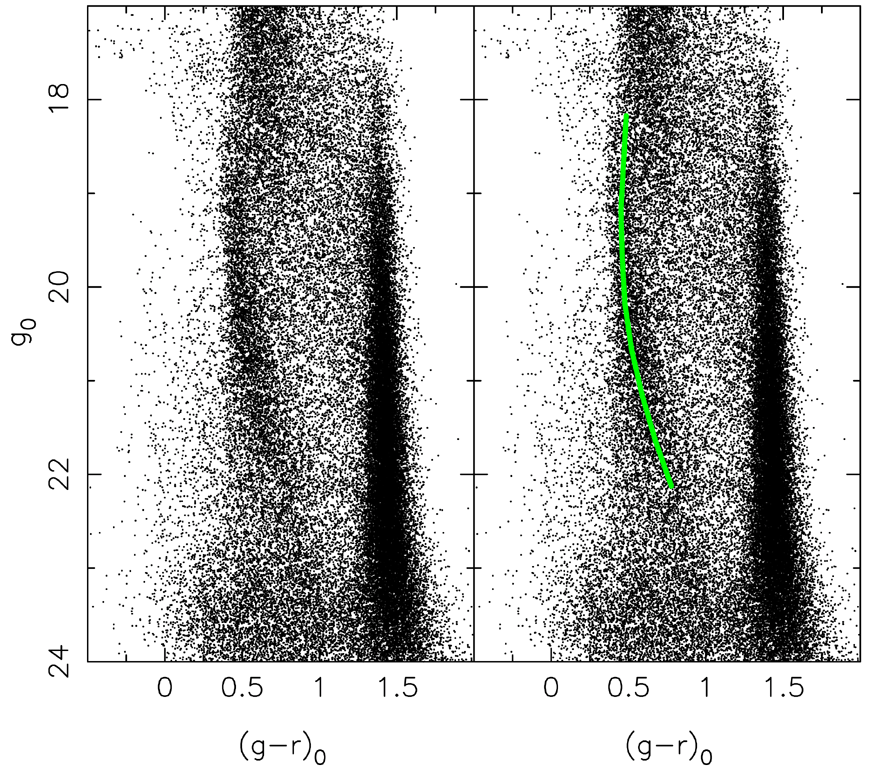
The INT WFS devotes a large fraction of observing time to deep and wide-field surveys. Many fields have now been observed since 1998. In examining INT WFC survey fields, the discovery team of astronomers has been able to detect the presence of this unexpected feature in several  distant fields. However, the resulting coverage at the present time is patchy, with most time having been spent in large extragalactic surveys towards the Galactic polar caps. In the following figure an example of one of these fields is displayed, the Elais field N1, located at l= 85°, b=+44°, which shows the normal Galactic stellar population sequences. The Galactic disc dwarfs contribute to the well-populated red vertical structure at ( g - r )0sim 1.4, whereas the progressive main-sequence turn-offs of the thick disc and halo give rise to the blue vertical structure at ( g - r )0sim 0.5. Eventually, at magnitudes fainter than g 0sim 22, the halo sequence curves round to the red because of the rapidly falling density at large Galactocentric distance. The right-hand panel shows the same data as the left-hand panel, but with the ridge-line of the structure of interest superposed.

Comparison field
The colour-magnitude diagram of the Elais field N1 (l= 85°, b=+44°), which it is used as a control field. This comparison region shows the usual Galactic components. [ GIF ]

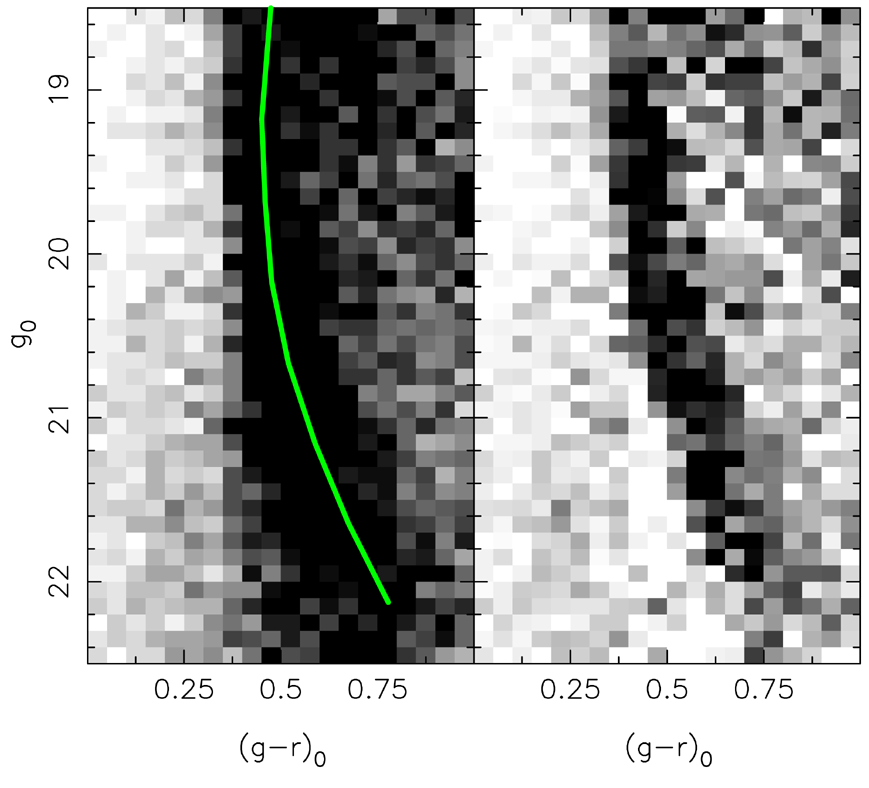
Next figure displays the colour-magnitude diagram of the INT WFC field WFS-0801 (located at l=180°, b=+30°); a population that follows a track similar to a narrow main sequence is seen in addition to the usual Galactic components. This sequence is shown more clearly in the right-hand panel of the following figure, in which the Elais-N1 field has been used as a background to subtract the normal Galactic components.

WFS-0801
The colour-magnitude diagram of a field WFS-0801 at l=150°, b=+20°. An additional colour-magnitude feature is present here over the expected disc, thick disc and halo components, and is seen as a narrow colour-magnitude diagram structure, similar to a main sequence with turn-off at ( g - r )0sim 0.5,  g 0sim 19.5 (in the Vega system). The right-hand panel shows this ridge-line overlaid on the colour-magnitude diagram. The similarity in the turn-off colour of this feature and that of the Galactic thick disc and halo shows that its stellar population is of comparable age to those ancient Galactic components. [ GIF ]


Zoom
The left-hand panel shows the Hess diagram of the INT WFS-0801 field  and the right-hand panel displays the result of subtracting the Elais-N1 comparison region from the data in the left-hand panel. The excess population stands out very clearly. This excess is detected at signal-to-noise ratio >30. [ GIF ]

It is clear that this structure cannot be related to the normal thin disc, as it lies several magnitudes below the expected thin disc sequence. The rapid decline in the density of the feature away from the Galactic plane also rules out a direct connection to the halo. This leaves the thick disc as the only normal Galactic option. However, its nature remains a puzzle, and it is difficult to ascertain whether it is a Galactic ring, an inhomogeneous mess arising from ancient warps and disturbances, or part of a disrupted satellite stream.

Ultimately, detailed studies of this kind of the structure of the Milky Way and other galaxies, reveal how they came into being and have evolved over the lifetime of the universe.  If this manifestly old population turns out to be the outer stellar disc, it will pose a very interesting challenge to galaxy formation models that predict inside-out assembly. Alternatively, if it transpires that the structure is due to a disrupted satellite whose orbit has been circularized and accreted along with its cargo of dark matter on to the disc, it will provide a unique first-hand opportunity to understand the effect of massive accretions on to the inner regions of galaxies.

Some references:


EXTRAGALACTIC

A DEARTH OF DARK MATTER IN ORDINARY ELLIPTICAL GALAXIES

WHT+PN.S

Over the past 25 years, astronomers have progressed from being surprised by the existence of dark matter to understanding that most of the universe is dominated by exotic nonluminous material. In the prevailing paradigm, the gravitational influence of cold dark matter (CDM) is crucial to the formation of structure, seeding the collapse and aggregation of luminous systems. An inherent consequence of CDM's role in these processes is that galaxies have massive, extended CDM halos. Indeed, such halos are evident around spiral galaxies, in which the rotational speeds in the extended cold-gas disks do not decrease outside the visible stars—a gravitational signature of dark matter.
 
The evidence for dark matter in elliptical galaxies is still circumstantial. Assessments of the total masses of individual elliptical systems have generally been confined to the very brightest systems, for which the gravitational potential can be measured using X-ray emission or strong gravitational lensing, and to nearby dwarfs, for which the kinematics of individual stars offer a probe of the mass distribution. More "ordinary" elliptical galaxies are more difficult to study because in general they lack a simple kinematical probe at the larger radii, where dark matter is expected to dominate. The velocity distribution of the diffuse stellar light is the natural candidate, but studies have been limited by the faintness of galaxies' outer parts to radii that are 2 Reff, where Reff is the galaxy's effective radius, which encloses half of its projected light.

A powerful alternative is offered by Planetary Nebulas (PNs), which are detectable even in distant galaxies through their characteristic strong emission lines. Once found, their line-of-sight velocities can be readily determined by the Doppler shift in these emission lines. These objects have been used in the past as tracers of the stellar kinematics of galaxies, but the procedure of locating them with narrow-band imaging surveys and then blindly obtaining spectra at the identified positions has proven difficult to implement efficiently on a large scale.

A specialized instrument, the Planetary Nebula Spectrograph (PN.S), was developed specifically to study the kinematics of PNs in elliptical galaxies. The PN.S uses counterdispersed imaging (a type of slitless spectroscopy) over a wide field to detect and measure velocities for PNs simultaneously by using their [O III] emissions at 500.7 nm. Because it is optimized for this purpose, the PN.S is far more efficient for extragalactic PN studies than any other existing instrumentation.

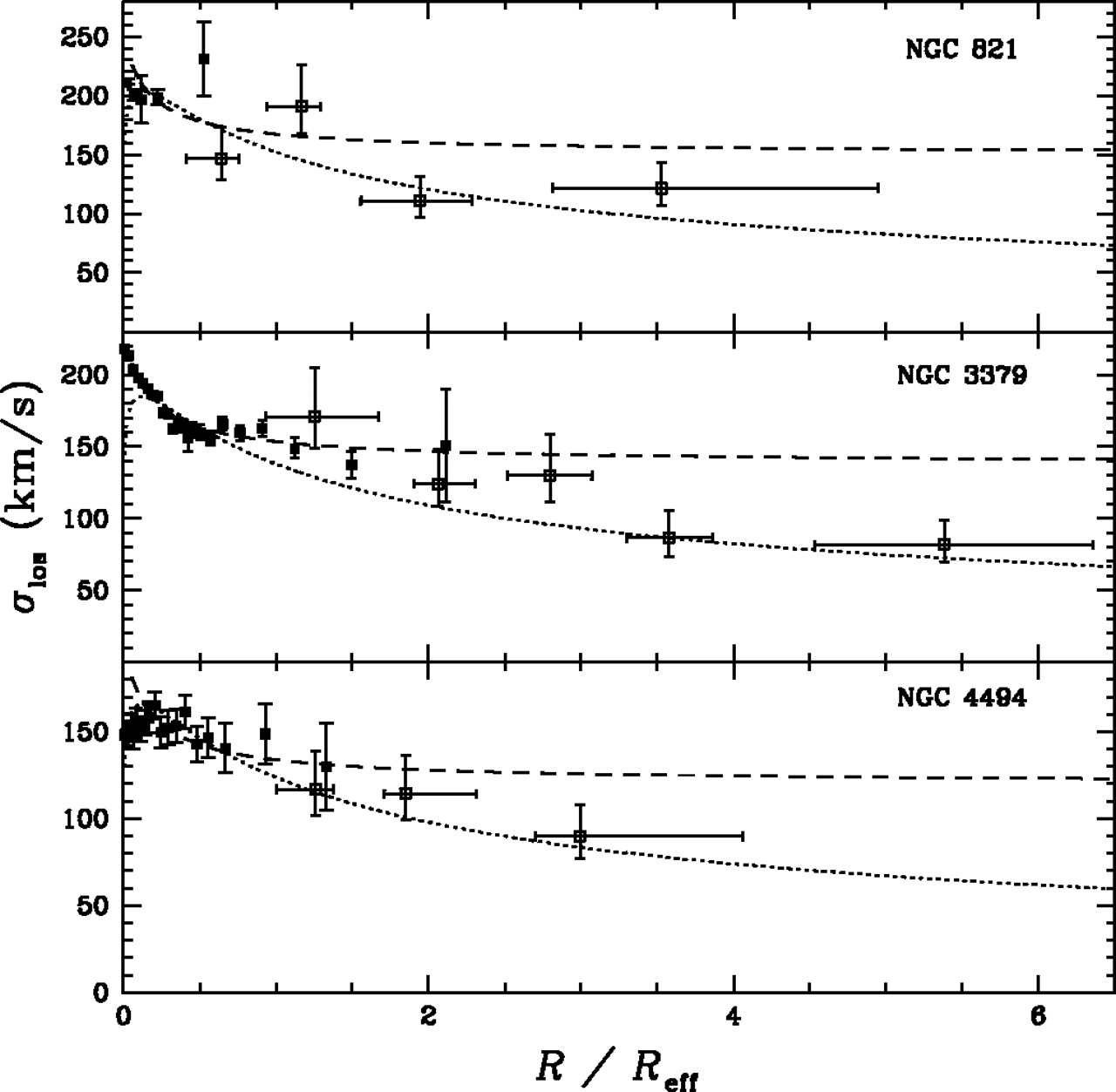
Observations with the PN.S on the William Herschel Telescope allowed astronomers to extend stellar kinematic studies to the outer parts of three intermediate-luminosity elliptical galaxies: NGC 821, NGC 3379, and NGC 4494. In each of these systems, they measured 100 PN velocities with uncertainties of 20 km s–1 out to radii of 4 to 6 Reff. The line-of-sight velocities in the outer parts of all of these galaxies show a clear decline in dispersion with the radius. A decrease in random velocities with the radius has been indicated by small samples of PNs around NGC 3379, but the more extensive data set presented here provides a more definitive measurement of this decline, and reveals that it also occurs in other similar galaxies. The new data are inconsistent with simple dark halo models and thus different from kinematical results for brighter ellipticals.

NGC 3379
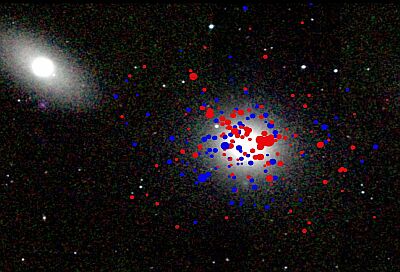
NGC 3379 (M 105) with 109 PN line-of-sight velocities relative to the systemic velocity, as measured with the PN.S instrument on the William Herschel Telescope. The symbol sizes are proportional to the velocity magnitudes. Red crosses indicate receding velocities, and  blue boxes, approaching velocities. Field of view is 8.4×8.4 arcmin=26×26 kpc=14×14 Reff. [ JPEG | TIFF ] .

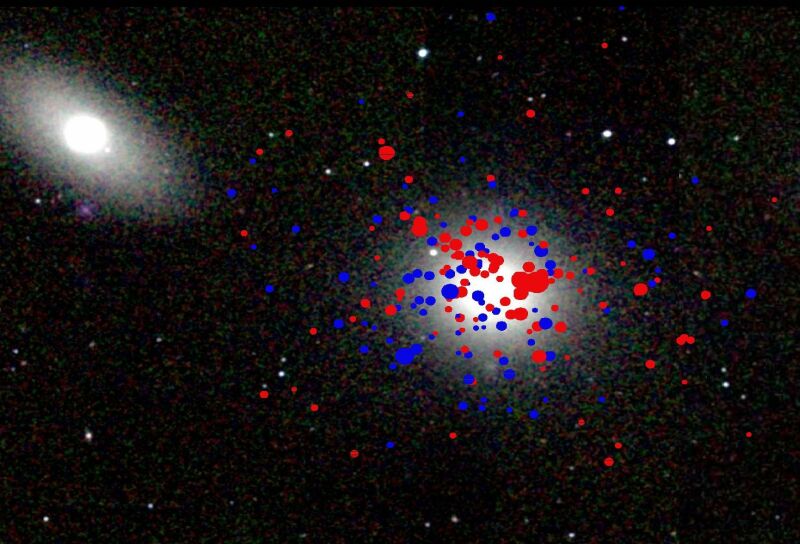
Another view of NGC 3379
This image shows the starlight from NGC 3379 (M 105) elliptical galaxy and its near neighbour, NGC3384. The dots show the positions of planetary nebulae located in this system: the colour of each dot shows whether the nebula is receding or approaching, while its size indicates its speed. Note how planetary nebulae can be detected well beyond the apparent edge of the galaxy, and that the dots tend to get smaller far from the galaxy, indicative of slow speeds and hence a lack of dark matter. [ TIFF | JPEG ]

More unexpectedly, the velocity dispersion data are consistent with simple models containing no dark matter, showing the nearly Keplerian decline with the radius outside 2 Reff that such models predict and suggesting that these systems are not embedded in massive dark halos.

Line-of-sight velocity dispersion
Line-of-sight velocity dispersion profiles for three elliptical galaxies, as a function of projected radius in units of Reff. Open points show planetary nebula data (from the PN.S); solid points show diffuse stellar data. The vertical error bars show 1 uncertainties in the dispersion, and the horizontal error bars show the radial range covered by 68% of the points in each bin. Predictions of simple isotropic models are also shown for comparison: a singular isothermal halo (dashed lines) and a constant mass-to-light–ratio galaxy (dotted lines). [ JPEG ]

This result clashes with conventional conceptions of galaxy formation. In particular, if ellipticals are built up by mergers of smaller galaxies, it is puzzling that the resulting systems show little trace of their precursors' dark matter halos. And it is also apparent that some important physics is still missing from the recipes for galaxy formation. For example, substantial portions of these galaxies' dark matter halos could have been shed through interactions with other galaxies. Such stripping has been inferred for ellipticals near the centers of dense galaxy clusters, but the galaxies studied here are in much sparser environments, in which substantial stripping is not expected to be an important process.

Crucial to understanding the incidence and origin of this low–dark matter phenomenon will be the results for a large sample of ellipticals with a broad range of properties, including differing environmental densities, which could be a key factor in determining halo outcomes; the continuing PN.S observing program will provide this sample.

Some references:


OBSERVATIONAL COSMOLOGY

EXTENDING COSMIC SHEAR MEASUREMENTS WITH THE WILLIAM HERSCHEL TELESCOPE

WHT+PFC

Weak gravitational lensing of background galaxies by intervening large-scale structure ('cosmic shear') provides direct information about the total mass distribution in the universe, regardless of its nature and state. Thus a measurement of cosmic shear bridges the gap between theory, which is primarily concerned with dark matter, and observation, which generally probes only luminous matter. The recent detection of coherent distortion of faint galaxies using the William Herschel Telescope in 2000  have triggered great interest in the provision of new constraints on the amount and distribution of dark matter, together with measurements of several cosmological parameters.

If intrinsic galaxy orientations are essentially random in a given survey, any coherent alignment must arise from distortion due to weak lensing. Light paths from galaxies projected close together on the sky pass through, and are gravitationally distorted by, the same dark matter concentrations. This coherent distortion contains valuable cosmological information. In particular, the variance of the distortion field measures the amplitude of density fluctuations (sim σ 8 Ω0.5m). This shear measurement is free from assumptions about Gaussianity or the M-T relation, and whilst the shear-based measurement is currently comparable in precision to that from local cluster abundance, further progress is limited solely by the number of fields observed.

The validity of results from cosmic shear surveys depends sensitively on the treatment of systematic errors. A further issue arises from sample (or 'cosmic') variance, the impact of which can be limited by using numerous independent sightlines to complement panoramic imaging of a few selected areas. With these motivations in mind, a team of astronomers compared the cosmic shear observed with two independent instruments (Keck and William Herschel Telescope), using two different survey strategies.

Astronomers extended the original detection of the cosmic shear on the William Herschel Telescope by increasing the number of observed fields, with a further increase in area as a result of the larger 16×16 arcmin2 size of field with the new prime focus mosaic camera. The aim of the survey was to acquire deep (z 1) fields representing numerous independent lines of sight, sufficiently scattered to sample independent structures and thus to minimize uncertainties owing to sample variance. These lines of sight were chosen in a quasi-random fashion, without regard to the presence or absence of mass concentrations, in order to obtain a representative sample of the mass fluctuations in the universe.

The cosmic shear with both Keck and WHT was measured at a signal-to-noise of 5.1, finding an amplitude of the matter power spectrum of σ 8m/0.3)0.68= 0.97 ± 0.13, with 0.14 <Ωm< 0.65, including all contributions to the 68 per cent confidence level uncertainty: statistical noise, sample variance, covariance between angular bins, systematic effects and redshift uncertainty. A measurement of this quantity from cosmic shear is cosmologically valuable, as it represents a direct measure of the amplitude of mass fluctuations.

Determination of parameters
Constraints on the joint distribution of Ωm and σ 8 for the combination of Keck and WHT measurements. [ GIF ]

These results for Keck and WHT are consistent with each other, strengthening confidence in control of systematics. The joint results are also consistent with other recent cosmic shear measurements. They also agree with the old cluster abundance normalization. However, they can not rule out lower cluster-abundance normalization which has been derived recently. This discrepancy, if confirmed, could arise from unknown systematics in either the cluster or cosmic shear methods. For the cluster method, further studies would be needed to understand the difference between the observed mass-temperature relation and that found in numerical simulations. It is important to understand the origin of the discrepancy between cosmic shear and cluster abundance methods. If this is not explained by such systematics, it could point towards a failure of the standard ΛCDM paradigm, and therefore have important consequences for cosmology.

Some references:


OTHER SCIENTIFIC HIGHLIGHTS BRIEFLY