Horse Head Nebula. The image on the left is
a 10s exposure using the 2-detector prime focus camera on the WHT. The
picture on the right is the same object as observed by the INT Wide Field
Camera.
 M13 Globular Cluster. This true-colour CCD image was taken using the Jacobus
Kapteyn telescope and the SITe2 detector, which covers an 11.3 arcmin field
of view. More information: A New
Detector on the JKT - ING Newsletter article.
M13 Globular Cluster. This true-colour CCD image was taken using the Jacobus
Kapteyn telescope and the SITe2 detector, which covers an 11.3 arcmin field
of view. More information: A New
Detector on the JKT - ING Newsletter article.
 M92 Globular Cluster. M92 is a splendid object, visible to
the naked eye under very good conditions and a showpiece for every optics.
It is only slightly less bright but about 1/3 less extended than
M13: its 11.2' angular extension corresponds to a true diameter of 85 light
years, and may have a mass of up to 330,000 suns. This image was achieved by combining
25s exposures in B, g' and r' and using the JAG CCD camera on the JKT (SITe2
detector). Credit: J Méndez (ING). [ TIFF ]
M92 Globular Cluster. M92 is a splendid object, visible to
the naked eye under very good conditions and a showpiece for every optics.
It is only slightly less bright but about 1/3 less extended than
M13: its 11.2' angular extension corresponds to a true diameter of 85 light
years, and may have a mass of up to 330,000 suns. This image was achieved by combining
25s exposures in B, g' and r' and using the JAG CCD camera on the JKT (SITe2
detector). Credit: J Méndez (ING). [ TIFF ]

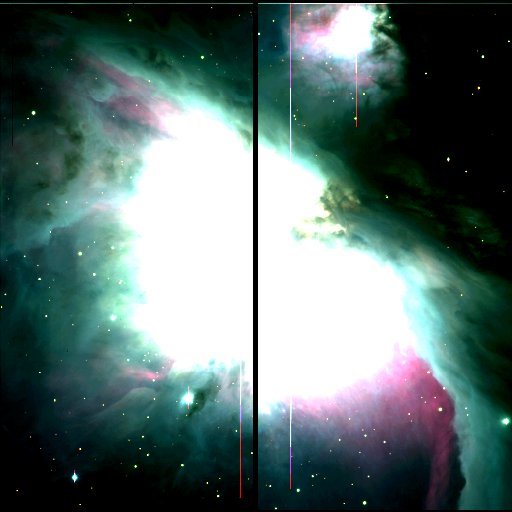
 This is the star-formation region M42, also known as the Orion nebula.
The gas and dust in the nebula emits light because it is irradiated by
nearby emerging stars. Shown here are 10s exposure true-colour pictures using BVR imaging
on the new WHT prime focus camera. [ TIFF ]. More
information: The New WHT Mosaic
Camera - ING Newsletter article.
This is the star-formation region M42, also known as the Orion nebula.
The gas and dust in the nebula emits light because it is irradiated by
nearby emerging stars. Shown here are 10s exposure true-colour pictures using BVR imaging
on the new WHT prime focus camera. [ TIFF ]. More
information: The New WHT Mosaic
Camera - ING Newsletter article.
 Observations of the globular cluster M15 using the Martini Adaptive
Optics system. The adaptive optics technique improves the image quality
by removing the effects of atmospheric seeing. View the uncorrected
and corrected K-band
images.
Observations of the globular cluster M15 using the Martini Adaptive
Optics system. The adaptive optics technique improves the image quality
by removing the effects of atmospheric seeing. View the uncorrected
and corrected K-band
images.

 Supernova SN 1994D in galaxy NGC 4526 and SN 1994I in galaxy M51 or the
Whirlpool galaxy (see below). Supernova SN 1994D is the star between the
star on the left and the galaxy. A supernova is an exploding star. During
the explosion, the supernova is as bright as the whole galaxy which hosts
the progenitor. SN 1994D was a type Ia supernova and SN 1994I a type Ic.
Jacobus Kapteyn Telescope took these pictures.
Supernova SN 1994D in galaxy NGC 4526 and SN 1994I in galaxy M51 or the
Whirlpool galaxy (see below). Supernova SN 1994D is the star between the
star on the left and the galaxy. A supernova is an exploding star. During
the explosion, the supernova is as bright as the whole galaxy which hosts
the progenitor. SN 1994D was a type Ia supernova and SN 1994I a type Ic.
Jacobus Kapteyn Telescope took these pictures.
 M57 Planetary Nebula, also known as the "Ring Nebula". This true-colour
image was taken by the Jacobus Kapteyn telescope and the SITe2 detector by
Simon Tulloch.
M57 Planetary Nebula, also known as the "Ring Nebula". This true-colour
image was taken by the Jacobus Kapteyn telescope and the SITe2 detector by
Simon Tulloch.
Galaxies
 This is an image of
NGC6496 taken with the Wide Field Camera on the Isaac Newton Telescope by Simon
Driver (St Andrews) on 12th June 1999.[ TIFF ]
This is an image of
NGC6496 taken with the Wide Field Camera on the Isaac Newton Telescope by Simon
Driver (St Andrews) on 12th June 1999.[ TIFF ]

 M33 Galaxy. The image on the left was obtained with the mosaic CCDs of
the Wide Field Camera at the INT. The image is a composition of frames taken
in three narrow bands: the green colour represents the galaxian emission in
[OIII] nebular line, red is the H-alpha hydrogen emission and blue is mainly
stellar light taken through a continuum filter centred at 555.0 nm
(Stromgren Y). In only one observing night, and with two positionings of the
telescope, it was possible to cover the whole galaxy which has a size of
approximately one degree in the sky. Landscape DIN-A4: [ JPEG | TIFF ]. Very large
format (480 mm wide): [ PDF | TIFF ]. More information: Another View of M33 - ING Newsletter
article. The image on the right is a true-colour imagen taken using the
2 detector WHT Prime Focus camera. Exposure time was 10s. [ JPEG | TIFF ]
M33 Galaxy. The image on the left was obtained with the mosaic CCDs of
the Wide Field Camera at the INT. The image is a composition of frames taken
in three narrow bands: the green colour represents the galaxian emission in
[OIII] nebular line, red is the H-alpha hydrogen emission and blue is mainly
stellar light taken through a continuum filter centred at 555.0 nm
(Stromgren Y). In only one observing night, and with two positionings of the
telescope, it was possible to cover the whole galaxy which has a size of
approximately one degree in the sky. Landscape DIN-A4: [ JPEG | TIFF ]. Very large
format (480 mm wide): [ PDF | TIFF ]. More information: Another View of M33 - ING Newsletter
article. The image on the right is a true-colour imagen taken using the
2 detector WHT Prime Focus camera. Exposure time was 10s. [ JPEG | TIFF ]
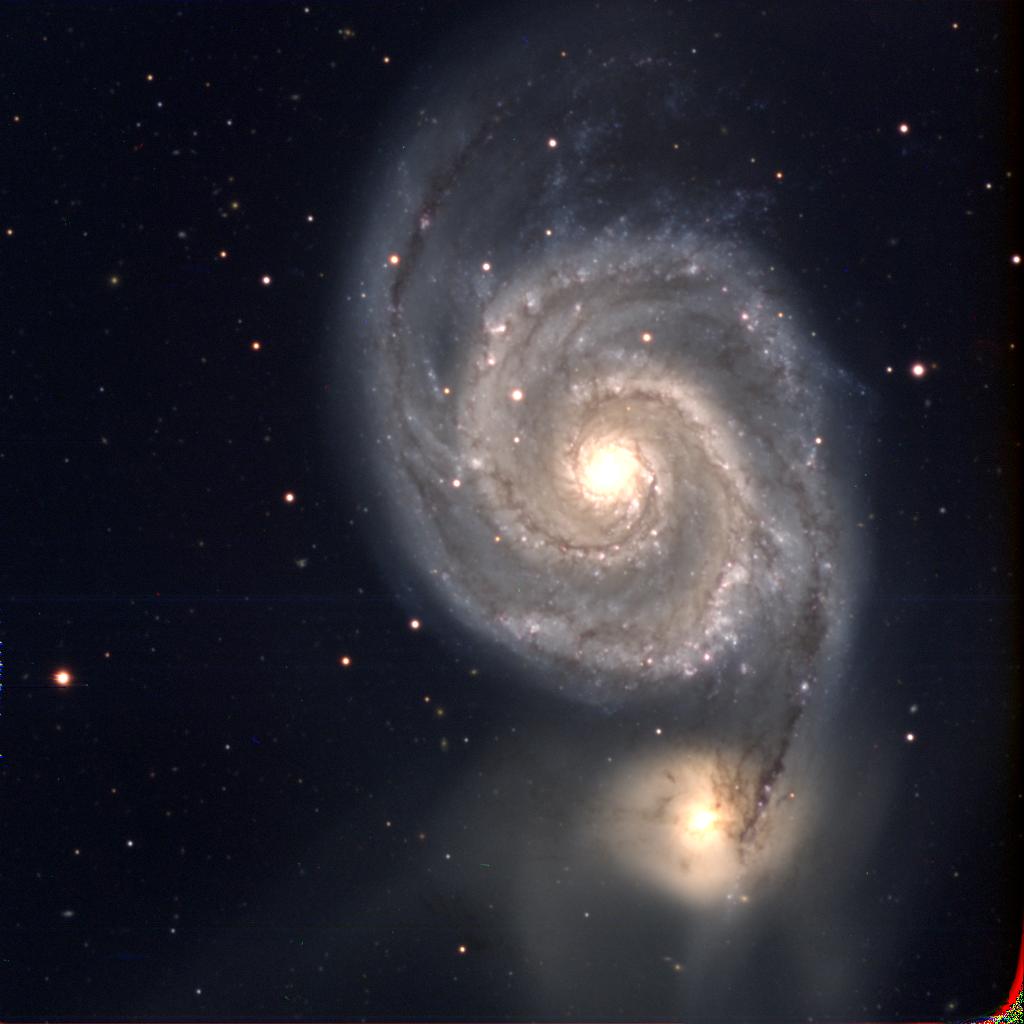
 M51 galaxy, known as The Whirlpool Galaxy M51, is a bright spiral galaxy
fairly close to us (7.5 Megaparsecs = 25 million light years = 231,450,000,000,000,000,000
kilometres). To the north of M51, at the bottom of the picture, is a companion
galaxy which is being disrupted by the gravitational tidal forces of the
main galaxy. Shown here is a true-colour picture using BVR imaging on the
new INT wide field camera. This picture was generated from two-minute
exposures taken by Peter Bunclark. The field size of this single Loral CCD
is 12.6 arcminutes. The Wide Field Camera consists of four of these science
chips with an additional fifth Loral CCD acting as the autoguider. The Loral
CCDs were later replaced by EEV CCDs.
M51 galaxy, known as The Whirlpool Galaxy M51, is a bright spiral galaxy
fairly close to us (7.5 Megaparsecs = 25 million light years = 231,450,000,000,000,000,000
kilometres). To the north of M51, at the bottom of the picture, is a companion
galaxy which is being disrupted by the gravitational tidal forces of the
main galaxy. Shown here is a true-colour picture using BVR imaging on the
new INT wide field camera. This picture was generated from two-minute
exposures taken by Peter Bunclark. The field size of this single Loral CCD
is 12.6 arcminutes. The Wide Field Camera consists of four of these science
chips with an additional fifth Loral CCD acting as the autoguider. The Loral
CCDs were later replaced by EEV CCDs.
 The galaxy Dwingeloo 1. This is a barred spiral galaxy, probably one
of the largest and nearest galaxies, but undiscovered until 1994. This
is because it is hidden behind the disk of our own galaxy, the Milky Way
- as a result more than 99% of its light is absorbed by dust in our galaxy
before it reaches us. The galaxy was discovered using a combination of
radio observations and INT CCD imaging. Shown here is a true colour picture
using VRI CCD imaging on the INT.
The galaxy Dwingeloo 1. This is a barred spiral galaxy, probably one
of the largest and nearest galaxies, but undiscovered until 1994. This
is because it is hidden behind the disk of our own galaxy, the Milky Way
- as a result more than 99% of its light is absorbed by dust in our galaxy
before it reaches us. The galaxy was discovered using a combination of
radio observations and INT CCD imaging. Shown here is a true colour picture
using VRI CCD imaging on the INT.
 A true colour image of M100 (NGC 4321), a barred galaxy in the Virgo
cluster, obtained using BVI CCD imaging on the INT. New infrared and optical
images taken with the WHT suggest that this "normal" spiral galaxy hides
a barlike structure in its heart. Credit: Johan Knapen, John Beckman,
Soledad del Rio and Maria J Sempere.
A true colour image of M100 (NGC 4321), a barred galaxy in the Virgo
cluster, obtained using BVI CCD imaging on the INT. New infrared and optical
images taken with the WHT suggest that this "normal" spiral galaxy hides
a barlike structure in its heart. Credit: Johan Knapen, John Beckman,
Soledad del Rio and Maria J Sempere.

 Most of the galaxies in the Universe lie in large clusters where gavitational
forces play an important role. These clusters are used to prove the Laws
of General Relativity because they act as large gravitational lenses, refracting
the light coming from the objects behind them. The galaxy cluster shown
on the left is Abell 1656 and the large elliptical galaxy in the middle is NGC4874.
Astronomers from the University of Durham found a
cosmic flow of galaxies across one billion light years of the Universe
by studying clusters like this one. The picture on the right is the rich
cluster of galaxies Abell 2219,
a massive gravitational lens. This is a three colour image based on a 2.5
hour H band exposure obtained with CIRSI camera combined with B and I band
optical CCD images, taken on the William Herschel Telescope. [ TIFF ]
Most of the galaxies in the Universe lie in large clusters where gavitational
forces play an important role. These clusters are used to prove the Laws
of General Relativity because they act as large gravitational lenses, refracting
the light coming from the objects behind them. The galaxy cluster shown
on the left is Abell 1656 and the large elliptical galaxy in the middle is NGC4874.
Astronomers from the University of Durham found a
cosmic flow of galaxies across one billion light years of the Universe
by studying clusters like this one. The picture on the right is the rich
cluster of galaxies Abell 2219,
a massive gravitational lens. This is a three colour image based on a 2.5
hour H band exposure obtained with CIRSI camera combined with B and I band
optical CCD images, taken on the William Herschel Telescope. [ TIFF ]
 INT CCD image in the near IR of the galaxy NGC 6822. The fact that this
galaxy is near enough for us to be able to resolve a large number of its
individual stars makes it possible to study the star formation history
based on colour-magnitude diagrams.BMP
version of the picture. These are true-colour pictures of the region
in the centre of the galaxy: RVB
IRV IRB
IVB. Exposure
times were 900s in I, 900s in R, 1000s in V and 1200s in B.
INT CCD image in the near IR of the galaxy NGC 6822. The fact that this
galaxy is near enough for us to be able to resolve a large number of its
individual stars makes it possible to study the star formation history
based on colour-magnitude diagrams.BMP
version of the picture. These are true-colour pictures of the region
in the centre of the galaxy: RVB
IRV IRB
IVB. Exposure
times were 900s in I, 900s in R, 1000s in V and 1200s in B.
 This
is a JKT image of the interacting galaxy pair Arp 239 or Mkn 271, also
known as the 'Telephone Receiver'. This image was taken during the RIXOS
survey.
This
is a JKT image of the interacting galaxy pair Arp 239 or Mkn 271, also
known as the 'Telephone Receiver'. This image was taken during the RIXOS
survey.
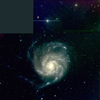 INT's Wide Field Camera picture of
M101 Galaxy. True-colour image .
INT's Wide Field Camera picture of
M101 Galaxy. True-colour image .
Observational Cosmology
 A true-colour image of faint blue galaxies at the edge of the observable
Universe, formed from a 30-hour B-band exposure and a 10-hour R-band exposure
at WHT prime focus. Detailed analysis of the colours shows that the bulk
of the faint blue galaxies lie at redshifts of about 2 and are probably
in their first phase of star formation. The number of galaxies means that
the space density of galaxies in the early Universe must have been much
higher than it is now.
A true-colour image of faint blue galaxies at the edge of the observable
Universe, formed from a 30-hour B-band exposure and a 10-hour R-band exposure
at WHT prime focus. Detailed analysis of the colours shows that the bulk
of the faint blue galaxies lie at redshifts of about 2 and are probably
in their first phase of star formation. The number of galaxies means that
the space density of galaxies in the early Universe must have been much
higher than it is now.
 On
February 28, 1997 William Herschel telescope took the first
picture of the optical counterpart of a gamma-ray burst (GRB), marked
OT - Optical Transient - on the picture (M dwarf is a dwarf star of type
M). This point of light is probably the most powerful explosion mankind
has ever witnessed. GRBs were discovered in the early seventies and their
origin has remained unsolved since then. Thanks to this picture, and later
investigations, we now know that these explosions take place outside our
galaxy. Nevertheless fundamental questions such as the origin of the events,
the source of energy, the triggering mechanism and the radiation processes
still remain to be determined.
On
February 28, 1997 William Herschel telescope took the first
picture of the optical counterpart of a gamma-ray burst (GRB), marked
OT - Optical Transient - on the picture (M dwarf is a dwarf star of type
M). This point of light is probably the most powerful explosion mankind
has ever witnessed. GRBs were discovered in the early seventies and their
origin has remained unsolved since then. Thanks to this picture, and later
investigations, we now know that these explosions take place outside our
galaxy. Nevertheless fundamental questions such as the origin of the events,
the source of energy, the triggering mechanism and the radiation processes
still remain to be determined.
 New studies of
supernovae in the farthest reaches of deep space indicate that the universe
will expand forever because there isn't enough mass in the universe
for its gravity to slow the expansion, which started with the Big Bang. This
image taken using the INT corresponds to a high-redshift type Ia supernova
thousands of millions of light years away. When a star explodes as a type Ia supernova its
brightness is similar to the host galaxy. This latter feature along with the
possibility of calibrating their maximum brightness, make type Ia supernovae the best known standard candles to investigate the geometry and
the dynamics of our universe. [ TIFF ]
New studies of
supernovae in the farthest reaches of deep space indicate that the universe
will expand forever because there isn't enough mass in the universe
for its gravity to slow the expansion, which started with the Big Bang. This
image taken using the INT corresponds to a high-redshift type Ia supernova
thousands of millions of light years away. When a star explodes as a type Ia supernova its
brightness is similar to the host galaxy. This latter feature along with the
possibility of calibrating their maximum brightness, make type Ia supernovae the best known standard candles to investigate the geometry and
the dynamics of our universe. [ TIFF ]
The Sky above La Palma
Milky Way in Sagitarius as seen from La Palma. This picture was taken by John Mills (ING) using amateur equipment. Sky above La Palma is protected by a Spanish law. Thanks to this, the most polluting village, Barlovento, has new public lights and the influence on the astronomical observations is now very low.
Nowadays the number of artificial satellites which populate our skies is very high. This picture is a good example. It is a 30 minute exposure in filter g, and it was taken using the JKT CCD camera. At least 3 satellites are visible (field of view is 5 arcminutes approximately and the position was 4 degrees away from the celestial equator). Credit: Javier Méndez (ING) [ TIFF ].

Leonids Meteor shower. On the night 16/17 November 1998 astronomers observing at ING witnessed a splendid spectacle.
Asteroid 3634 Iwan. 2.8x2.8 arcmin image obtained on the night of 30/31 August 1995 using the 1.0m Jacobus Kapteyn Telescope. More images of asteroids can be found in Alan Fitzsimmons' asteroids web page. Our telescopes have also observed and discovered the most distant Kuiper Belt Objects.

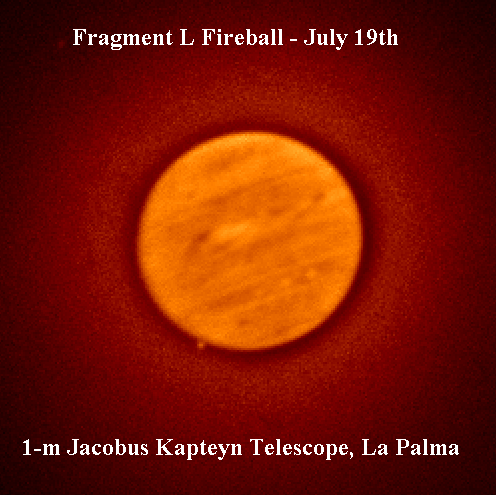
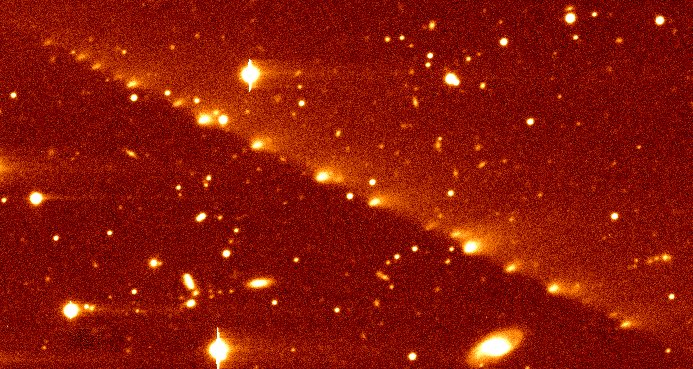
In July 1994 the individual fragments of Comet Shoemaker-Levy 9 impacted onto the planet Jupiter. Images obtained from the 1m Jacobus Kapteyn Telescope clearly showed the ejecta plume of debris rising over the planet's limb from the impact site of fragment L. At the same time the 2.5m Isaac Newton Telescope was used to observe spectroscopic emission from the vaporised comet, revealing some of its constituent elements. More information can be found on Alan Fitzsimmons' web page.
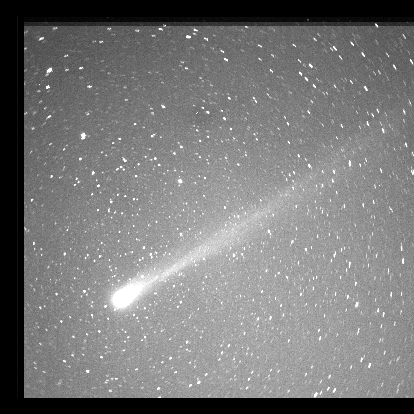
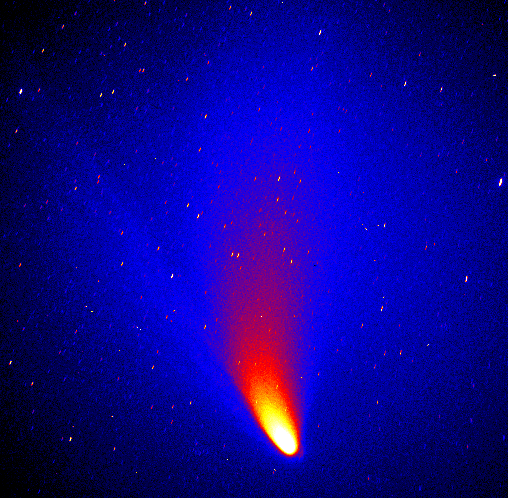
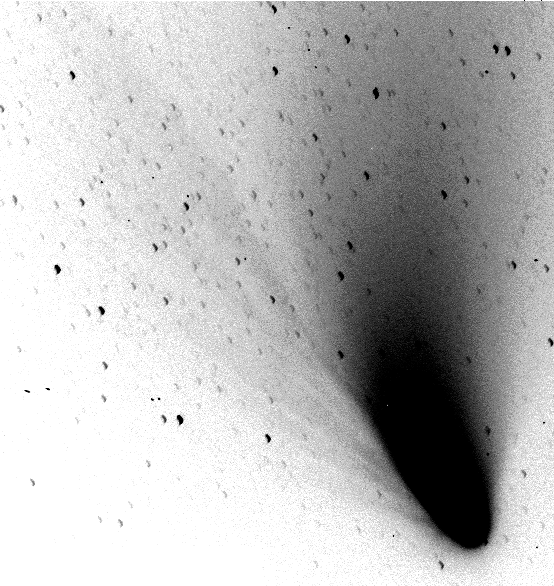
Comet Hyakutake observed from La Palma using a CCD detector mounted on a 35-mm telephoto lens on the night of 24 March 1996. At this time the Comet was making an extremely close approach to the Earth passing within 14 million kilometers (about 9 million miles) from us. This is the closest approach of a comet for 13 years and the brightest comet within the last 20 years. At this time the Comet extended some 30 degrees in the sky which translates to a physical length of around 6 million kilometres (about 4 million miles) and was easily visible to the naked eye having an apparent brightness equal to that of the brightest stars. Its apparent diameter was equal to three full moons while its real diameter was around 250000 kilometres (150000 miles).


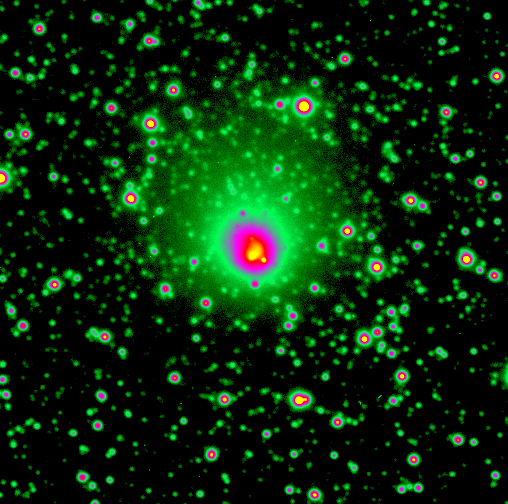
Comet Hale-Bopp was a spectacular object in the evening skies during the spring of 1997. This comet was observed using the 1 m Jacobus Kapteyn Telescope. The image here was obtained on the 25th of August, 1995 when the comet was 6.9 AU (1030,000,000 kilometres) from the sun and 6.3 AU (940,000,000 kilometres) from the Earth. A large number of stars are visible, as at this time the comet was in the direction of the constellation of Sagittarius. On the 1st March, 1997 William Herschel telescope took this CCD image which shows a spiral jet and some dusty arcs ejected from the nucleus. CoCAM camera, the wide field imaging facility of ING, began to observe comet Hale-Bopp on the first days of March, 1997. These 10.5 degrees and 6 degrees pictures at 618 nanometers are good samples of the observations carried out. Finally, on the 16th April CoCAM discovered a new type of cometary tail, the sodium tail (the straight line from the right bottom to the left top of the last picture), which consists of neutral atoms, never seen before.
Saturn with edge-on rings as observed by William Herschel Telescope in 1995.
Horse Head Nebula. The image on the left is a 10s exposure using the 2-detector prime focus camera on the WHT. The picture on the right is the same object as observed by the INT Wide Field Camera.