|
Preparing observations with OSCA Be also aware that, as OSCA is not cooled, the mask substrates will contribute to the thermal background. Therefore observations in the K band should be taken with extreme care or preferably in H band (if possible). Do take a look at the OSCA features page. Please let ING staff know well in advance if you are planning to use OSCA during INGRID observations. The AO system needs some fine tuning which has to be done during day time. Which mask size to useThe question which mask size to use depends first on the scientific goal and second on the seeing conditions. Potential observers have to be aware that the PSF of an AO system has a diffraction limited core but a significant amount of light is also scattered in a halo with the size of the seeing disk. It is therefore recommended to use a mask corresponding to the actual seeing conditions or try to use always the maximum still suitable mask for your science case.PSF referencesSubtracting a PSF reference from the science target enhances the sensitivity significantly. To do so one can either rotate the actual science observation and subtract the rotated image from the non-rotated one (this only will help if you are looking for pointsources). Or one observes a PSF reference and subtract that from the acutal science observation. In the latter case the observer should also prepare a list of possible PSF reference objects. PSF references should be selected according to the following criteria:
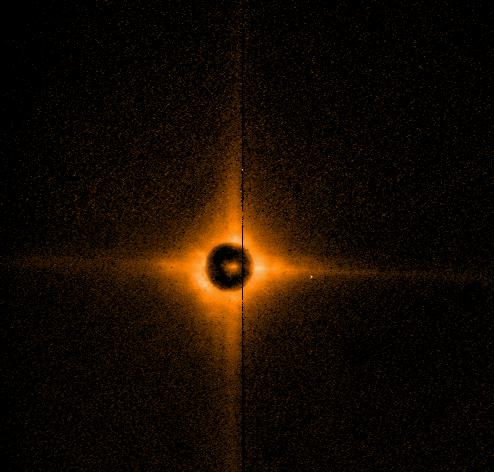
Be aware that PSF observations are time consuming and the observer has to account for this overhead when asking for time in his proposal. Also, keep in mind that since atmospheric conditions are always changing, PSF references may not be an accurate representation of the actual PSF during the observations of the target.ObservationsCentering an object behind a stop is currently done manually. This can be time consuming, especially for faint objects (up to 10 minutes) and this overhead should also be accounted for when applying for observing time. For bright stars, the star can be seen through the mask (see sample image on the left), which aids centering. For faint stars the star will disappear completely behind the mask unless the integration time is long enough.
Depending on the needs of the sciences, the observer should then bracket the observations of the
science target with PSF reference(s) observations. Also, please have a look at the
OSCA observers guide by P. Doel .
|
 |
Last Updated: 23.06.05 R. Østensen |