|
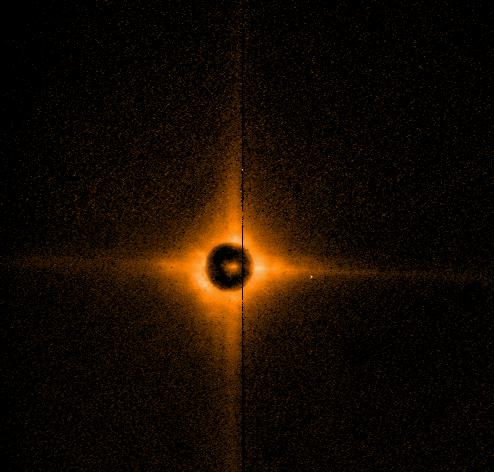
OSCAOSCA (Optimised Stellar Coronograph for Adaptive Optics) is a coronograph that is an integral part of the NAOMI adaptve optics system, and can be used together with the infrared camera, INGRID. It was installed and commissioned in 2002 and has been offered to the community since 2003A. OSCA was built at the Optical Science Laboratory of the University College London (UCL) by Peter Doel (PI). Click here to go to the UCL webpage for OSCA OSCA effectively suppresses light of a bright object and therefore enables the detection of faint structures or objects close to the host object which are otherwise overshined. OSCA is mounted permanently after the AO system NAOMI at the WHT and can be deployed within a few seconds into the beam making the system very flexible during nighttime. Nevertheless potential observers are asked to inform ING staff well before their run if they are going to use OSCA as it requires some preparation of the AO system to be fully optimized for the use of the coronograph. Please consult the page about preparation of observations before writing a proposal. Currently six different mask sizes with hard edges are permanently mounted inside OSCA: 0"2, 0"65, 0"8, 1"0, 1"6 and 2"0. Two gaussian shaped masks with fwhm=0"5 and 0"6 optimized for the optical wavelength domain are also available. All masks can be selected remotely. OSCA can only be used in combination with INGRID for near infrared (J, H, Ks or narrow bands) imaging observations. There is no possibility of using OSCA with OASIS.
|
 |
Last Updated: 13.08.06 Ian Skillen |