The PSF (point spread function) yielded by an adaptive-optics system depends on:
AO performance can be characterised in terms of achieved FWHM, FWHE (full width including half the energy) or Strehl (ratio between the peak heights of corrected and diffraction-limited PSFs). In the optical, the NAOMI-corrected PSFs are near-gaussian in form, so FWHM is a particularly useful metric. It can be misleading if the PSF has a narrow core (e.g. in the IR) superimposed on a plateau of uncorrected seeing, with the latter including most of the light.
Measurements and predictions of NAOMI's performance are given below. The first section deals with the PSF at the position of the guide star, the second section with degradation of PSF as a function of distance from the guide star.
Even with no atmosphere, and with perfect optical surfaces, NAOMI will not deliver a perfect diffraction-limited PSF. The segmentation of the primary mirror, stopping down of pupil, and support vanes for central-obscuration stops all degrade the PSF.
Natural seeing 0.7 arcsec (median for La Palma):
| Guide star mag |
B/V (0.5 mic) | R (0.65 mic) | I (0.82 mic) | Z (1.05 mic) | J (1.25 mic) | H (1.65 mic) | Ks (2.15 mic) |
| <= 8 | 0.3 | 0.3 | 0.3 | 0.3 | 0.25 | 0.15 | 0.15 |
| 9 | |||||||
| 10 | 0.5 | 0.4 | 0.3 | ||||
| 11 | 0.4 | 0.4 | 0.35 | 0.25 | 0.2 | 0.2 | |
| 12 | 0.5 | 0.5 | 0.5 | 0.3 | 0.3 | 0.3 | |
| 13 | 0.4 | 0.4 | 0.4 | ||||
| 14 | 0.5 | 0.6 | 0.5 | 0.4 | 0.4 | 0.4 | |
| 15 | 0.5 | 0.5 | 0.4 | 0.4 | 0.4 | ||
| 16 | 0.5 |
Natural seeing 0.5 arcsec:
| Guide star mag |
B/V (0.5 mic) | R (0.65 mic) | I (0.82 mic) | Z (1.05 mic) | J (1.25 mic) | H (1.65 mic) | Ks (2.15 mic) |
| <= 8 | 0.2 | 0.2 | 0.15 | 0.2 | 0.15 | 0.15 | |
| 9 | 0.25 | 0.2 | 0.2 | ||||
| 10 | |||||||
| 11 | 0.40 | 0.30 | 0.2 | 0.2 | |||
| 12 | 0.2 | 0.2 | |||||
| 13 | 0.3 | 0.25 | |||||
| 14 | 0.4 | ||||||
| 15 | 0.4 |
NAOMI was not designed to deliver useful performance in seeing > 1.2 arcsec, and there has been no systematic characterisation in such seeing, but it does deliver some improvement e.g. PSF 0.4 arcsec in H band, in natural seeing ~ 1.5 arcsec, in Sep 2006.
To convert seeing in J, H and K bands to seeing in V band, multiply by 1.2, 1.2 and 1.3 respectively.
For comparison, the theoretical WHT diffraction limits in J, H and Ks bands are 0.07, 0.08 and 0.12 arcsec.
On one occasion, a bright star was observed through ~ 3 mags of cloud, but the FWHM in Ks band was still improved from 0.6 -> 0.2 arcsec, i.e. cloud doesn't necessarily preclude good AO correction.
The above measurements were all made using an 8*8 lenslet array in the Shack-Hartmann wavefront sensor. A 4*4 lenslet array is available, giving higher S:N for faint stars but poorer spatial sampling. This faint-star mode has been commissioned but is not yet fully tested. It should allow useful performance to be achieved when closing the loop on faint stars V > 14. In the longer term, the use of `zero-noise' CCDs in the wavefront sensor offers another potential gain in mag limit. Each 1-mag increase in the guide-star limit corresponds to a factor of 3 increase in sky coverage.
Strehl values have not yet been measured from the commissioning data. The predicted strehls below are based on theoretical models of NAOMI performance (i.e. not including any commissioning results) by Ron Humphries and Richard Wilson, Durham. They assume use of the standard lenslet array (i.e. 8*8, not 4*4).
Predicted Strehl in natural seeing 1.0, 0.7 and 0.5 arcsec, for each band at each guide-star V mag:
| J | H | K | |||||||
| Guide-star mag | 1.0" | 0.7" | 0.5" | 1.0" | 0.7" | 0.5" | 1.0" | 0.7" | 0.5" |
| 11 | 0.15 | 0.29 | 0.38 | 0.29 | 0.45 | 0.54 | 0.46 | 0.62 | 0.69 |
| 12 | 0.08 | 0.21 | 0.31 | 0.19 | 0.36 | 0.46 | 0.34 | 0.51 | 0.61 |
| 13 | 0.03 | 0.12 | 0.22 | 0.08 | 0.24 | 0.35 | 0.19 | 0.38 | 0.50 |
| 14 | 0.01 | 0.04 | 0.11 | 0.02 | 0.10 | 0.21 | 0.06 | 0.21 | 0.35 |
Seeing 1.0, 0.7 and 0.5 arcsec correspond to Fried parameter r0 = 10, 15 and 20 cm respectively.
For Strehl ratios of more than a few tenths, the bulk of the light will be concentrated in a diffraction-limited core (FWHM ~ 0.15 arcsec in K), with the remainder of the light distributed over the (uncorrected) natural-seeing disk. With poorer AO correction, there will still be a diffraction-limited core, but it will contain only a small fraction of the light. The delivered FWHM is typically close to either the diffraction limit or the tip-tilt-corrected seeing diameter.
The above performance predictions do not take into account wavefront errors induced by the telescope on spatial scales too small (< 50 cm) to be sampled by the spots of the wavefront sensor, although experience with ELECTRA suggests that these are not large.
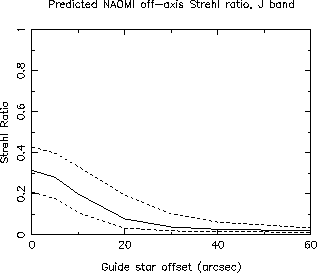
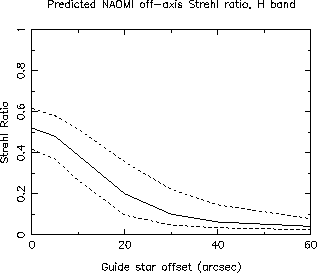
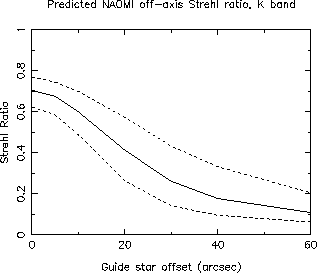
Strehl ratio is predicted to fall to half its on-axis value at distances 13, 17 and 23 arcsec from the guide star in J, H and K respectively (the size of the isoplanatic patch scales as wavelength6/5). That is, for a given degree of correction, the guide star needs to be closer to the target for J and H imaging than for K. The sky coverage, i.e. the fraction of sky falling within the anisoplanatic patch of a bright star, depends on required Strehl, and on galactic latitude. In K band, for delivered Strehl 0.3, predicted sky coverage is ~ 10% at galactic latitude 30 deg.
So far, few measurements have been made of the deterioration of PSF with distance from the guide star. These few measurements indicate that the isoplanatic patch is larger than given above, perhaps because the seeing is dominated by turbulent layers at a lower altitude than expected.
Predictions of the decline in delivered Strehl with separation between target and guide star, for J, H and K bands are shown below. The 3 curves are for median and for 25 and 75 percentile seeing conditions, with a bright guide star, V ~ 12. These predictions were provided by Richard Wilson and the Durham team.
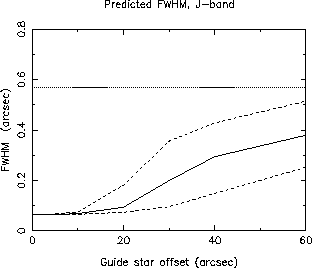
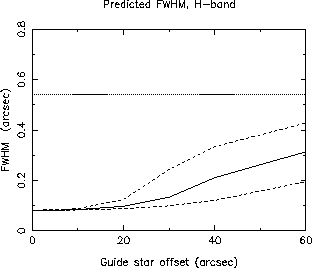
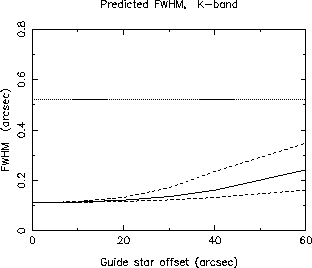
Below are the predicted variation of FWHM (median, and 25 and 75 percentile) with separation from the guide star:
and of 50%-included-energy diameter (FWHE):
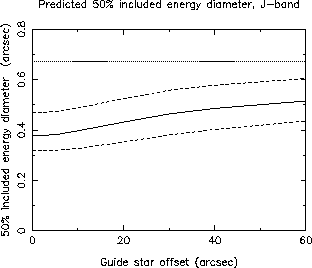
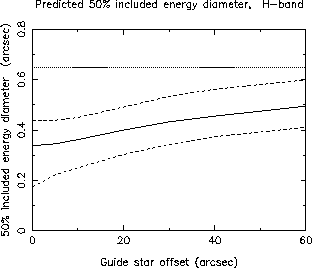
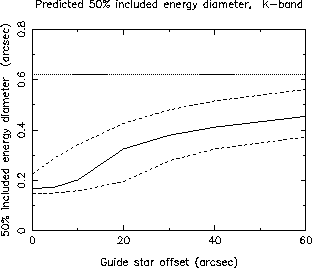
The horizontal dotted lines in the figures indicate the median uncorrected values. Median predicted FWHM is < 0.2 arcsec for guide-star distance = 30, 40 and 50 arcsec in J, H and K. At the same distances, the 50% encircled-energy diameters are about 0.4 arscec in each band. I.e. the FWHM can be close to the diffraction limit even when there is < 50% of the total energy in the central peak.
 |