

| LIRIS sensitivity
|
|||||||||||||||||||||||||||||||||||||||||||||||||||||||
|
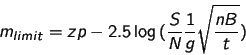
The limiting magnitude of an IR instrument depends on the required signal to noise ratio, the exposure time, the sky background brightness and, for point sources, on the seeing. Using an equation of McLean (1997), where
The following table lists characteristics measures for LIRIS as determined during the first commissioning in February 2003. Note that B can vary by a factor of 2.5 and more, depending on the season and the solar cycle. In J and H, B is dominated by airglow, whereas in Ks the temperature of the atmosphere determines B. Typically, the infrared sky brightness is smaller in winter and during periods of small solar activity.
IAC will provide a stand-alone exposure time calculator for LIRIS. |
|||||||||||||||||||||||||||||||||||||||||||||||||||||||
|
|
|
 |
Last Updated: 10 May 2004 Mischa Schirmer ( ) |
|
|
|